
We design and manufacture antireflection, reflective, beamsplitter and filter coatings for UV, visible and near-infrared optics. Our service covers coating development, deposition and spectral verification, from prototype components to production batches.
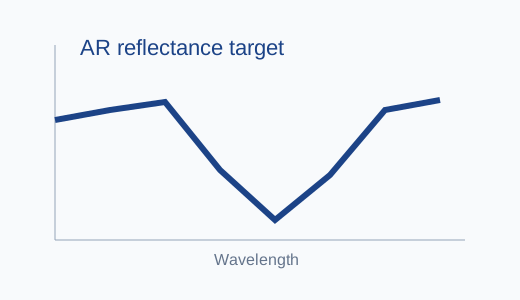
Single-wavelength, dual-band and broadband designs; typical broadband average reflectance below 0.5% across the specified operating band.
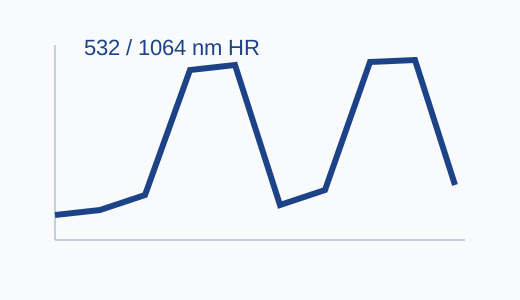
Broadband and laser-line reflectors. A visible-band example provides average reflectivity above 98% from 400–750 nm at 0–45° AOI, for all polarization states.
Protected and enhanced aluminum or silver coatings provide broadband reflection. We select the metal and protective layers around the operating spectrum and environmental requirements.
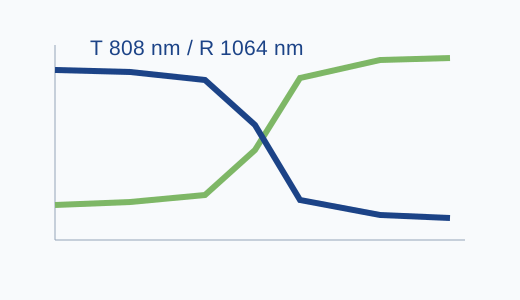
Polarizing, broadband non-polarizing hybrid and dichroic designs, including longpass, shortpass and multiband coatings. Transmission and reflection are specified at the operating AOI.
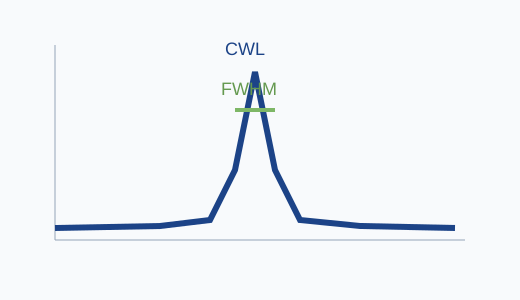
Hard-coated example: 10 nm passband, OD4 blocking; typical LIDT 1 J/cm² at 532 nm, 10 ns. Designed for spectral performance rather than high laser damage resistance.
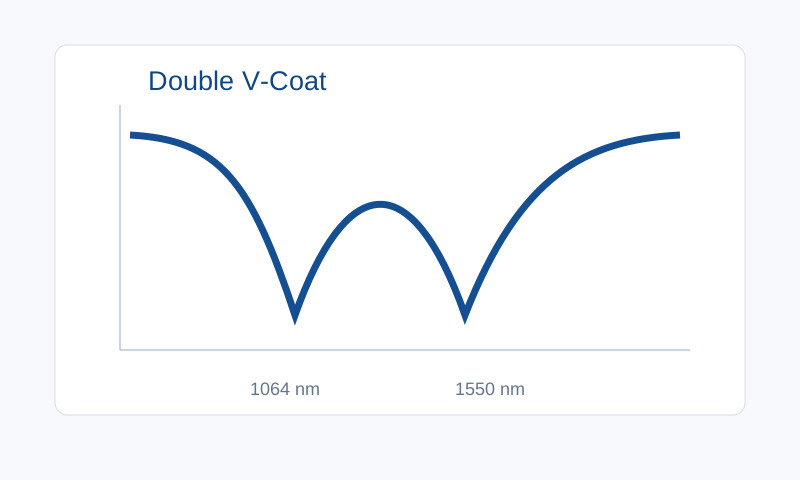
A 532/1064 nm fused-silica window design has AR coatings on both surfaces: reflection below 0.25% at 532 nm and below 0.1% at 1064 nm.
We develop multilayer designs with OptiLayer, FilmStar and TFCalc, and provide theoretical spectral curves during quotation and development. Supplied spectral data can also be used to model a coating.
Our deposition options also include ion beam sputtering for dense films and precise thickness control. We design, CNC-machine and fit-check custom fixtures to maximize coating area while protecting the substrate. During deposition, we monitor material and layer behavior and control chamber parameters for repeatability. Finished coatings undergo spectral and environmental testing before shipment.
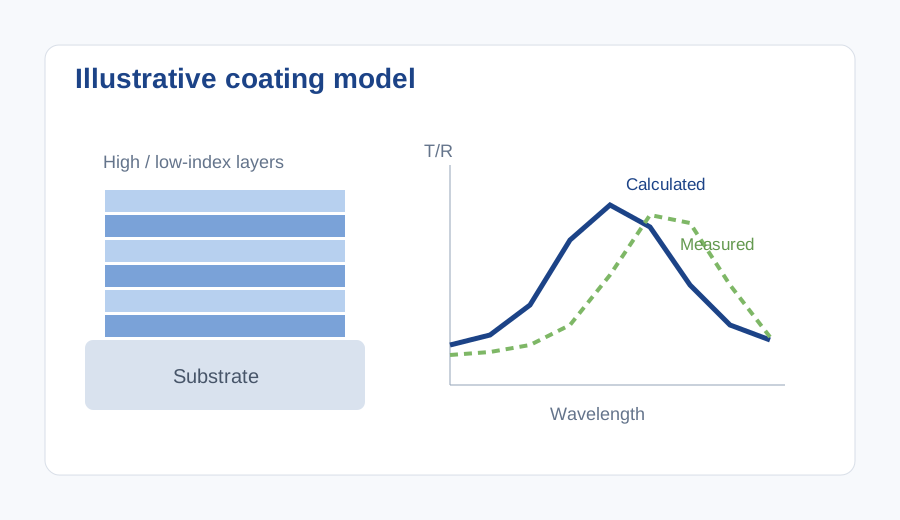
We measure transmission and reflection using UV–VIS–NIR spectrophotometry and evaluate polarization-dependent performance. Variable-angle absolute reflectance testing covers 10°–70°. We provide measured spectral curves and raw data for comparison with the design. The measurement range is separate from the coating service range.
| Spectral Range | Absolute Reflectance AOI | Polarization |
|---|---|---|
| 200–3200 nm | 10°–70° | S / P |
Send your target spectrum, substrate material, dimensions, AOI, polarization and quantity. For an existing design, include the coating specification or drawing so we can review deposition and testing requirements.