
We work with instrument designers to develop optical filters for fluorescence, spectroscopy, imaging and other light-based systems. Whether your project calls for a custom passband, several spectral channels or a filter that fits an unusual optical assembly, our engineering support connects filter design with the application and its manufacturing requirements.
A filter’s performance depends on how it works with the light source, detector and optical path. Our design work considers these relationships together, matching transmission and blocking to the wavelengths that contribute to the measurement.
Imaging applications also require attention to transmitted wavefront distortion, substrate wedge and thickness. In non-imaging detection systems, some of these requirements can be relaxed without compromising the measurement. This gives us room to develop a filter that delivers the required spectral response without adding unnecessary manufacturing cost.
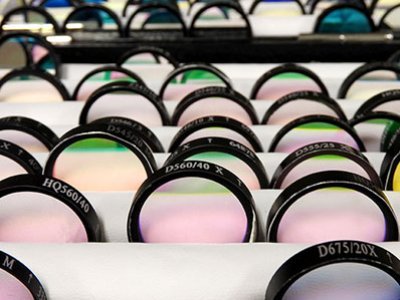
Our engineers support feasibility review, design refinement and preparation for production. Angle of incidence and beam cone angle are evaluated during development because tilting an interference filter shifts its spectrum toward shorter wavelengths, while polarization splitting can change the shape of the passband.
We also review the specifications that drive coating complexity. Blocking can be tailored to the source and detector rather than extended across wavelengths the system never uses. Where the application permits, adjustments to edge steepness or wavelength tolerance can reduce coating thickness or improve manufacturing yield while preserving the required system performance.
Our design services include single-band and multiband bandpass filters, notch filters, edge filters and dichroic beamsplitters. Non-standard spectral shapes and tunable designs extend the options for instruments that need a more specialized optical response.
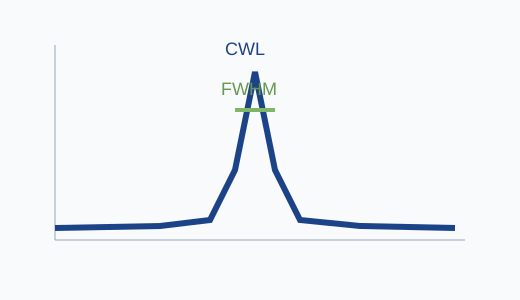
One multi-cavity design combines a nominal 660.1 nm center wavelength, FWHM <0.35 nm and >85% absolute transmission at normal incidence, with OD5 blocking over 200–651 nm and 666–1200 nm.
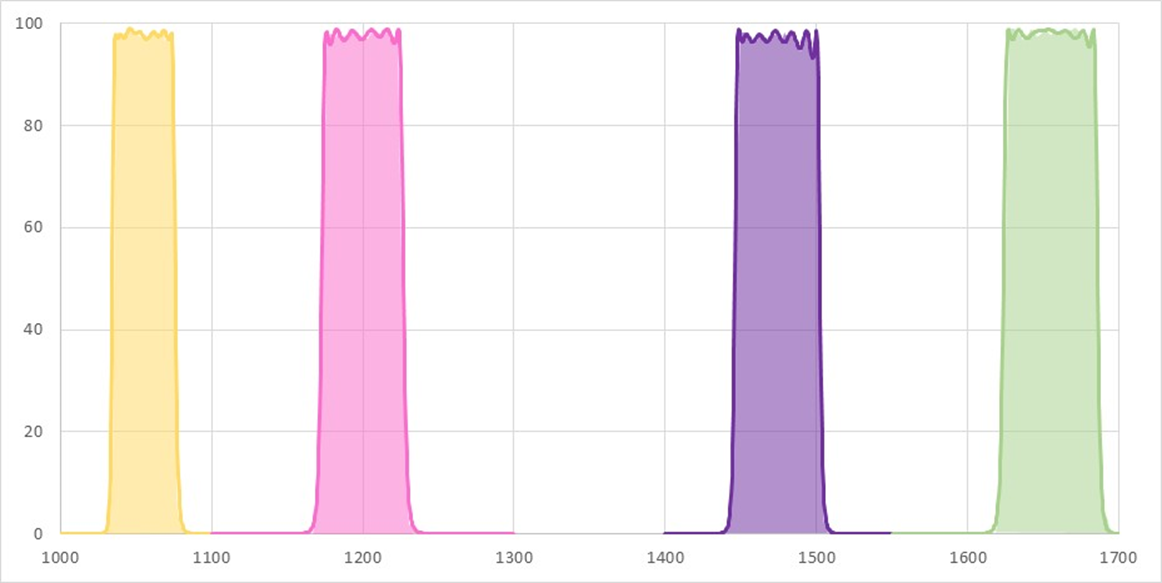
Multiband designs support simultaneous fluorescence channels, with options for more than ten passbands, >OD8 inter-band blocking and transmission up to 98%. Performance depends on the selected wavelengths and design.
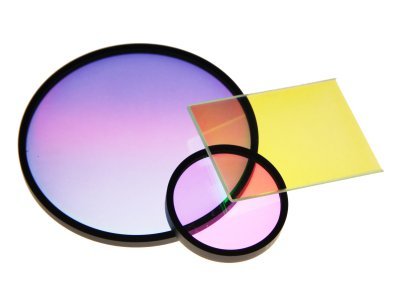
Custom substrates include cut corners, flats, ovals and irregular profiles. Precision machining and mechanical masking support filters that fit compact housings or carry separate coating zones on one substrate.
Our spectral testing supports verification of transmission, blocking and the placement of spectral features. Production lots are measured against the agreed specifications, with the measurement method selected for the filter’s optical response.
| Spectral Measurement Range | Dynamic Range | Resolvable Spectral Features |
|---|---|---|
| 200–3300 nm | 100% transmission to OD8 | 0.1 nm or greater |
For sub-nanometer passbands, measurement limitations can affect the reported transmission. Verification therefore accounts for the instrument’s resolution as well as the filter’s specified bandwidth.
We provide application and engineering support for custom development, build-to-print filters and repeat production. Our team works with you to refine the design, assess manufacturing feasibility and develop a filter suited to your instrument.