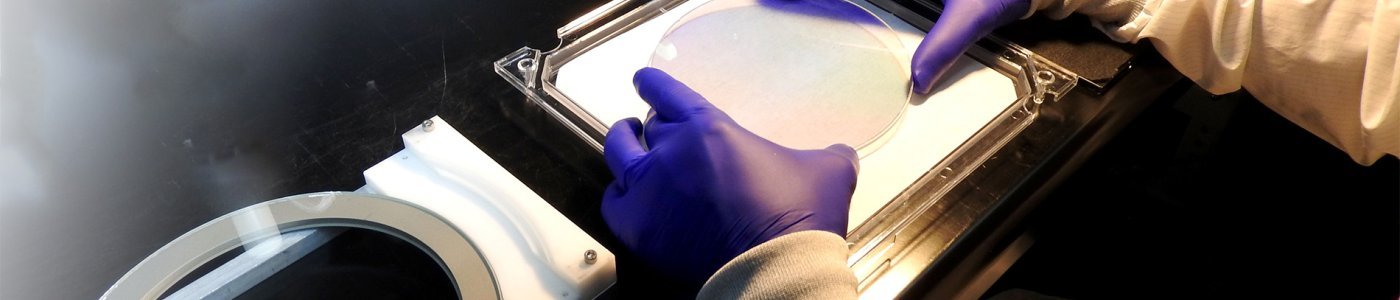
We develop optical coatings for high-power lasers, ultrafast systems and infrared instruments. Our services include anti-reflection coatings, high reflectors, output couplers, thin-film polarizers and dispersion-controlled mirrors, with designs adapted to the laser’s operating regime and the function of the optic.
Our laser coatings include designs for Yb- and Nd-based systems in the 1020–1080 nm region. Cavity mirrors, turning mirrors, pump mirrors and output couplers are developed for continuous-wave, nanosecond or picosecond operation.
One fiber-laser output-mirror design combines R >99.8% over 915–980 nm with R <3% over 1030–1200 nm at normal incidence, with an AR coating on the rear surface.
Ultrafast coatings address reflectance together with spectral phase. Low-GDD mirrors, chirped mirrors and Gires–Tournois interferometer mirrors provide options for pulse preservation and dispersion compensation.
Within the 550–1100 nm high-power ultrafast coating range, selected designs are optimized for GDD <50 fs².
IR coating services accommodate CaF₂, sapphire, germanium and ZnSe substrates. Options include laser-line AR coatings, dielectric reflectors and metallic mirrors.
Germanium windows are available with AR designs for 3–5 μm, 8–12 μm or 3–12 μm, serving mid-infrared, thermal-imaging and broadband multispectral applications.
Continuous-wave and pulsed lasers place different demands on a coating. In femtosecond systems, materials that improve damage resistance can limit bandwidth. One high-power turning-mirror approach provides approximately 100 nm bandwidth for p-polarization at 45°, sufficient for pulses as short as 25 fs.
For exposed IR windows, diamond-like carbon coatings provide abrasion and corrosion resistance. Pairing DLC on the exposed surface with conventional AR on the rear balances durability and transmission, while BBAR on both surfaces generally favors higher throughput.
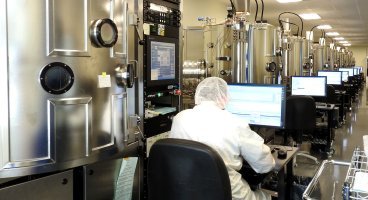
Coating design and deposition are developed together. Available routes include electron-beam evaporation, ion-assisted deposition and ion beam sputtering, with the process selected for the coating materials, optical response and substrate.
Infrared laser-line examples include an electron-beam-deposited 4.0 μm AR coating on CaF₂ with R <0.5% at normal incidence, and a 2.94 μm dielectric reflector on CaF₂ with R >99.7% at 45°. These values describe the coated surface, excluding rear-surface effects.
Verification extends beyond the transmission or reflection curve. White-light interferometry measures GD and GDD over 350–2400 nm, at 0–60° incidence, for both polarizations. Single mirrors and mirror pairs can be evaluated.
Laser damage results are specified with their test conditions. A typical IBS coating example at 1064 nm has the following LIDT:
| Wavelength | Typical LIDT | Pulse Duration / Repetition Rate |
|---|---|---|
| 1064 nm | 30 J/cm² | 20 ns / 10 Hz |
We work with you to develop a coating for its role in the optical system, balancing spectral performance, pulse behavior, substrate compatibility and durability. Engineering support covers custom designs and application-specific verification.