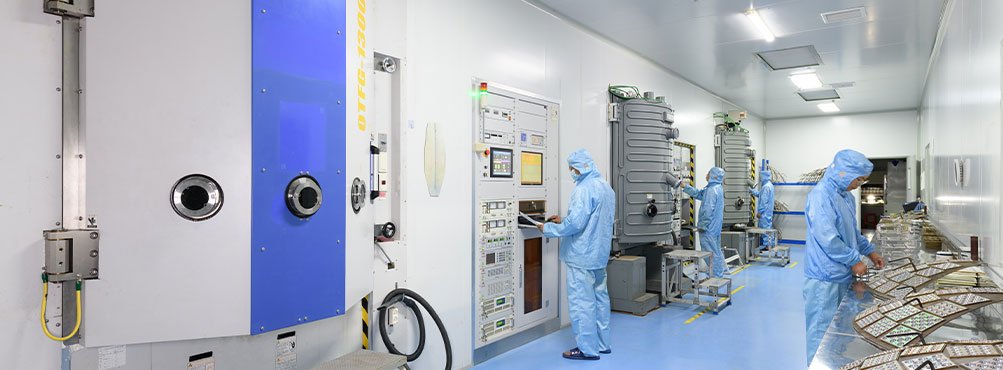
BANDOPTIC is an optical filter manufacturer based in Guangzhou, China that grew out of a glass company. We design, coat, cut and test interference filters for instrument makers, from single prototypes to production runs.
We make filters from a 222 nm UV bandpass to a 7,350 nm mid-infrared filter, with blocking up to OD6 and laser-line filters below 0.3 nm wide. Every standard filter has its full specification on this site.
Bandoptic at a Glance
Specialty:
Thin-film interference filters and coated optics
Experience:
more than 15 years in optical glass and filters
Location:
Yunpu Industrial Zone, Huangpu District, Guangzhou, China
Spectral range:
222 nm to 7,350 nm (standard filters); 200–2,500 nm (custom CWL)
Coating processes:
e-beam evaporation, ion-assisted deposition, magnetron sputtering, ion-beam sputtering
Spectral testing:
Agilent Cary 5000 and Cary 7000 UMS
Certifications:
ISO 9001:2015
How We Coat
E-Beam Evaporation (EBE)
High rate and capacity, run in high vacuum with substrates heated to about 250 °C.
Ion-Assisted Deposition (IAD)
EBE plus a plasma source for denser, lower-stress films with no thermal shift.
Magnetron Sputtering (MS)
Metal is sputtered, then oxidized by plasma, giving very dense and hard coatings.
Ion-Beam Sputtering (IBS)
The most advanced PVD process: below 150 °C, uniform over about 300 mm.
Compare the four processes Learn more

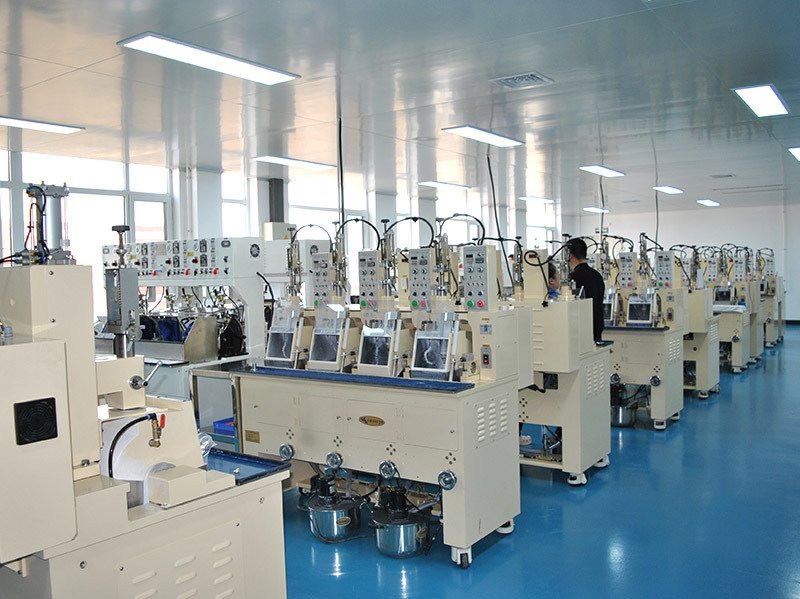
Under one roof we polish to λ/10 flatness and 5 arc-second parallelism, fabricate parts from 2 to 350 mm, and test from −192 °C to +500 °C, including cryogenic testing to 77 K.
Measured, Not Assumed
Every spectrum we publish is measured on an Agilent Cary 5000 UV-Vis-NIR spectrophotometer, which covers 175 to 3,300 nm. Charts state the instrument used; full test conditions are available on request.
For dichroic mirrors and beamsplitters, our Cary 7000 Universal Measurement Spectrophotometer measures absolute reflectance and transmittance at different angles and in s- and p-polarization without moving the sample. Mid-infrared filters above 3,300 nm are specified from design and supplier data.
Our specifications state tolerances, not just nominal values: typically ±2 nm on center wavelength and bandwidth, 0±2° angle of incidence and a 3.5° cone half-angle. Above the instrument’s noise floor, we quote blocking from the specification, not from the curve. See how we test

Every spectrum we publish is measured on an Agilent Cary 5000 UV-Vis-NIR spectrophotometer, which covers 175 to 3,300 nm. Each chart states the angle of incidence, polarization, instrument and test date, so you can compare it with your own measurements.
For dichroic mirrors and beamsplitters, our Cary 7000 Universal Measurement Spectrophotometer measures absolute reflectance and transmittance at different angles and in s- and p-polarization without moving the sample. Mid-infrared filters above 3,300 nm need FTIR data, which we add as it becomes available.
How We Work
We tell you what we measure: the tolerances, the test conditions, and the limits of the instrument that measured it.
When a standard filter does not fit, we start from your numbers: center wavelength, bandwidth, blocking OD, size, angle of incidence and operating temperature. Specify a custom filter
Industries We Serve
Our filters go into instruments that measure light: qPCR and fluorescence readers, flow cytometers, biochemistry analyzers, LiDAR and rangefinders, Raman spectrometers, machine-vision and laser-marking systems, and astronomical cameras.
Our Story
BANDOPTIC began as a glass company, supplying optical glass and precision fabrication. We added thin-film coating to make our own filters, then a metrology lab built around Agilent Cary 5000 and Cary 7000 spectrophotometers. Today we cut, polish, coat and test every filter in one facility.
Today we make more than 150 standard filters, plus custom designs, for customers worldwide. To discuss a project, contact our engineers. Contact Us