
Dichroic Mirrors & Filters
Dichroic Mirrors That Reflect One Band and Transmit Another
A dichroic filter separates light by color through thin-film interference, not absorption: it transmits one band of wavelengths and reflects the rest.
Because the unwanted light is reflected rather than absorbed, and the coating is built from hard metal-oxide layers, a dichroic is more durable and handles heat better than an absorbing color filter. Our hard oxide dichroics operate at up to 200 °C, hold their spectrum over a wide temperature range and resist humidity and UV exposure.
We make dichroic mirrors for 45° from 300 to 1,100 nm, with more than 92–95% average transmission in the pass band and more than 95–98% reflection in the reflect band.
Choose a longpass or shortpass split, a band design that reflects on both sides, or an RGB splitter for 445, 520 and 645 nm. The same coatings are the dichroic mirrors in our qPCR and fluorescence microscopy filter sets.
Need another edge or angle? Specify a custom filter

Where Dichroic Mirrors Are Used
Fluorescence microscopy and qPCR. The dichroic separates excitation from emission: it reflects the excitation light toward the sample and passes the longer-wavelength emission on to the detector.
Imaging, projection and machine vision. Dichroics split or combine color channels, such as red, green and blue at 445, 520 and 645 nm, or sort colors for inspection.
Laser and beam-combining systems. Set at 45°, a dichroic folds one wavelength out of the beam path while another passes straight through, so two sources can share one path or one beam can feed two detectors.
Lighting and astronomy. Dichroics create clean color effects in architectural and stage lighting, and isolate spectral lines in astronomical instruments.
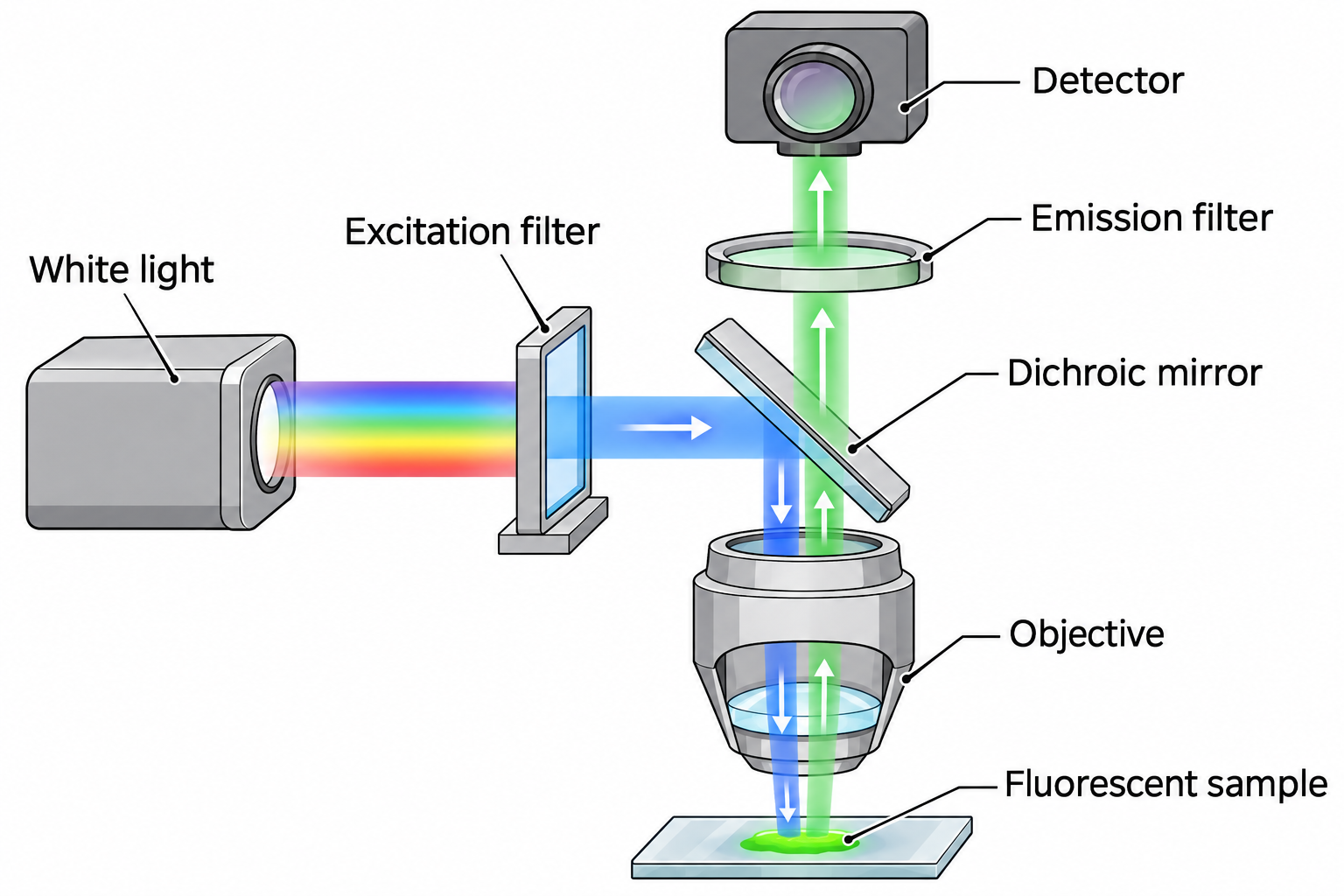 D01 · IMAGE PENDINGFluorescence cube light path with the DM505 bands
The Dichroic in a Filter Set
In a filter set, the dichroic reflects the excitation band toward the sample and transmits the emission band to the detector. On DM505, that is 450 to 490 nm reflected and 515 to 700 nm transmitted. Matched filter sets
Four Kinds of Dichroic
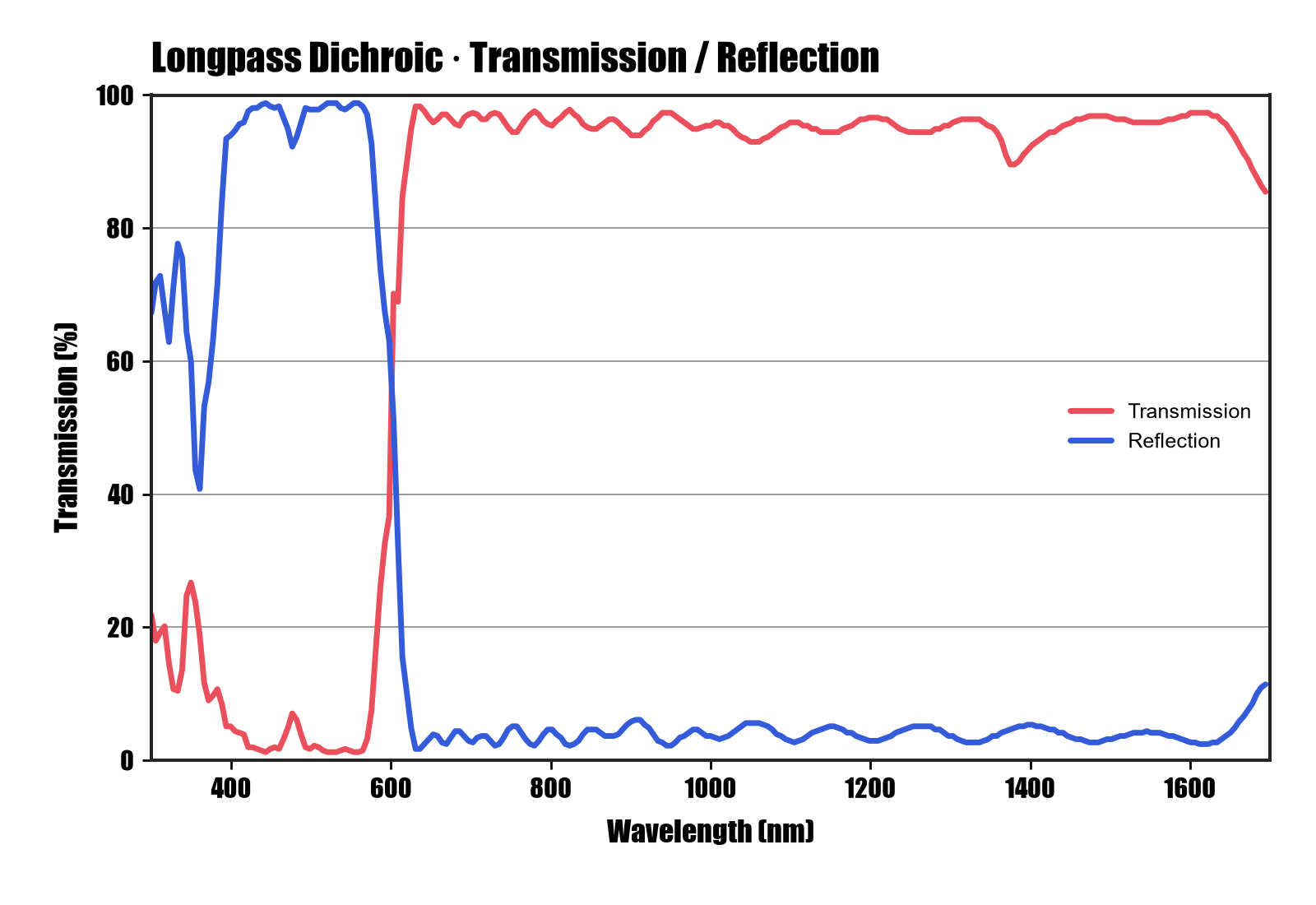 D02 · IMAGE PENDINGLongpass dichroic curve
Longpass Dichroics
Reflect the shorter band and transmit the longer one. The usual choice in fluorescence: our set dichroics reflect excitation light anywhere from about 340 to 755 nm and pass the emission up to 900 nm.
 D03 · IMAGE PENDINGShortpass dichroic curve
Shortpass Dichroics
Reflect the longer band and transmit the shorter one. For example, pass 400 to 580 nm and reflect 600 to 700 nm, or pass a UV line at 340 nm while reflecting 525 to 940 nm.
Band Dichroics
Transmit a middle band and reflect on both sides. For example, pass 565 to 680 nm and reflect 450 to 540 nm and 705 to 760 nm.
RGB Splitters
45° designs that pass or reflect combinations of 445, 520 and 645 nm, ±10 nm, to separate or combine red, green and blue channels.
Designed for 45°
A dichroic’s bands move when the angle of incidence changes: as the angle grows, the transmitted and reflected bands shift. That is why each dichroic is designed for the angle it will be used at. Ours are designed for 45° with a 3° cone half-angle.
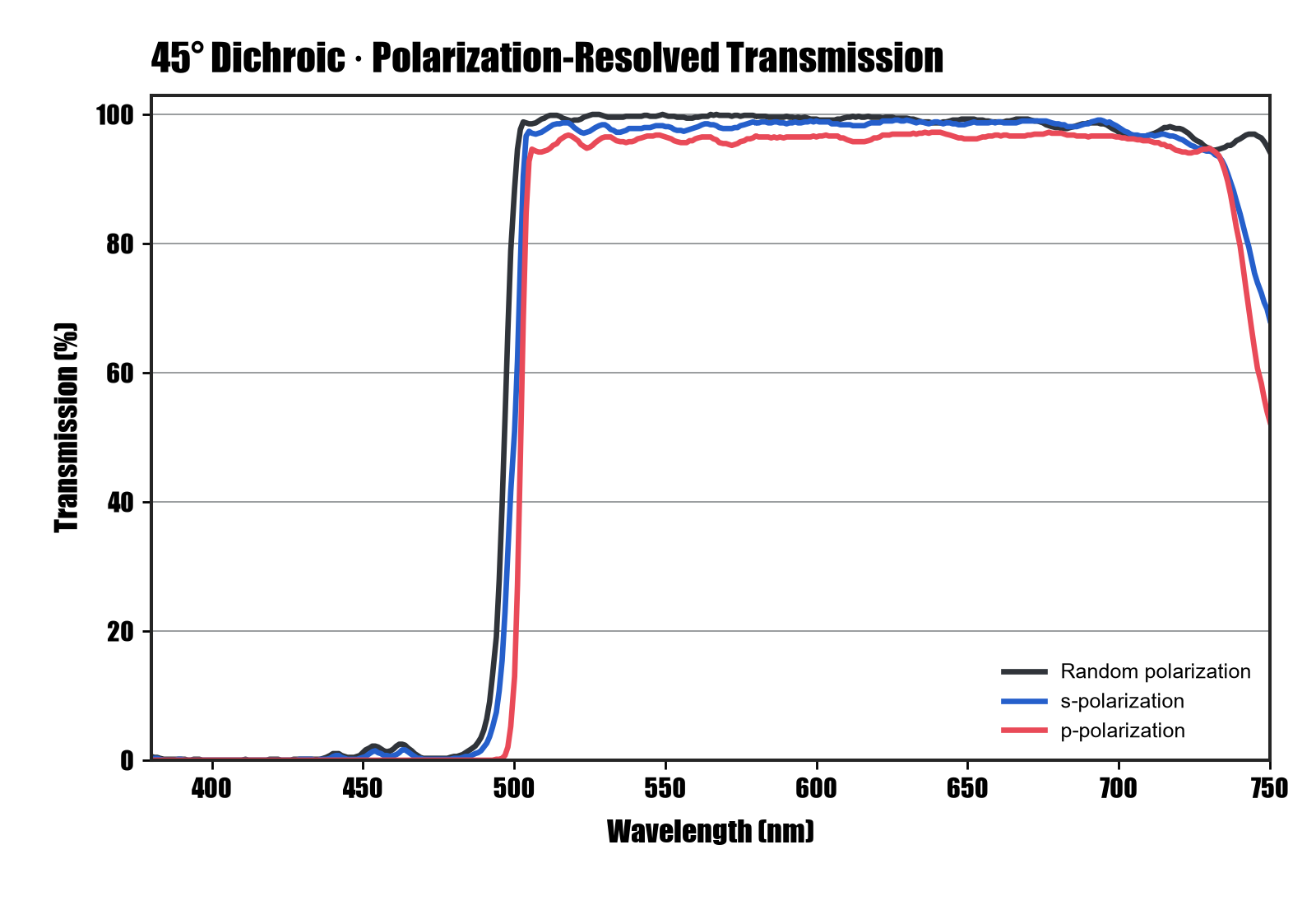 D06 · IMAGE PENDINGS, p and average curves of a dichroic at 45 degrees
At 45° we measure every design on our Agilent Cary 7000 Universal Measurement Spectrophotometer, which records absolute transmission and reflection at different angles and in s and p polarization without moving the sample. Each filter is tested for spectral accuracy, surface quality and mechanical stability.
We build dichroics two ways. Hard oxide dielectric coatings alternate high- and low-index layers with precisely controlled thickness for sharp transitions, minimal absorption and high-power use. Enhanced metal-dielectric hybrid coatings add metallic layers for stronger out-of-band blocking, better angle tolerance at non-normal incidence and better polarization behavior, and are optimized for UV and deep blue wavelengths.
Specs are written in three ways: average transmission over the pass band (TAvg), minimum transmission anywhere in it (TMin), and on some designs the 50% edge itself, for example 500 ± 3 nm.
The dichroic curves we supply show average polarization at 45°; s- and p-polarized curves are available on request.
The curves show how s and p polarization change dichroic transmission at 45 degrees, together with their average response.
Standard Dichroic Mirrors
| Model | Type | Pass band (nm) | Transmission | Reflect / block band (nm) | Reflection / blocking | AOI |
|---|---|---|---|---|---|---|
| Dichroic 45D-HR300-380/HT420-700 | Longpass | 410–700 † | TMin > 93% | 200–380 | T < 3% | 45° |
| DM415 | Longpass (set) | 435–700 | — | 340–400 | — | 45° |
| DM450 | Longpass (set) | 465–680 | TAvg ≥ 95% | 380–445 | R ≥ 95% | 45° |
| Dichroic 45D-HR450-492/HT512-800 | Longpass | 512–800 | TAvg > 95%, TMin > 90% | 450–492 | TAvg < 5% | 45° |
| DM505 | Longpass (set) | 515–700 | TAvg ≥ 95% | 450–490 | R ≥ 95% | 45° |
| DM550 | Longpass (set) | 560–700 | TAvg ≥ 95% | 450–538 | R ≥ 95% | 45° |
| DM565 | Longpass (set) | 575–700 | TAvg ≥ 95% | 450–555 | R ≥ 95% | 45° |
| DM590 | Longpass (set) | 605–700 | TAvg ≥ 95% | 450–580 | R ≥ 95% | 45° |
| DM600 | Longpass (set) | 615–700 | TAvg ≥ 95% | 450–590 | R ≥ 95% | 45° |
| Dichroic 45D HR350-605,HT620-720 | Longpass | 620–720 | TAvg > 95% | 350–605 | RAvg > 95% | 45° |
| DM635 | Longpass (set) | 650–700 | TAvg ≥ 95% | 450–630 | R ≥ 95% | 45° |
| DM647 | Longpass (set) | 665–700 | TAvg ≥ 95% | 450–640 | R ≥ 95% | 45° |
| DM660 | Longpass (set) | 675–750 | — | 450–650 | — | 45° |
| DM700 | Longpass (set) | 715–800 | TAvg ≥ 95% | 450–685 | R ≥ 95% | 45° |
| DM770 | Longpass (set) | 780–900 | TAvg ≥ 95% | 600–755 | R ≥ 95% | 45° |
| Dichroic 45D-HT340/HR525-940 | Shortpass | 340 | TMin > 90% | 525–940 | TAvg < 5% | 45° |
| Dichroic HR600-680,HT400-580 | Shortpass | 400–580 | TAvg > 95% | 600–680 | RAvg > 98% | 45° |
| Dichroic 45D-HT400-580/HR600-700 | Shortpass | 400–580 | TAvg > 95% | 600–700 | RAvg > 98% | 45° |
| Dichroic 45D HR450-540/HT565-680/HR705-760 | Band | 565–680 | TAvg > 92% | 450–540 / 705–760 ‡ | RAvg > 98% | 45° |
All at 45° with a 3° cone half-angle. “(set)” marks the dichroic mirrors used in our qPCR and microscopy filter sets. † Pass band from 410 nm. ‡ Two reflect bands.
Additive filters: 1.0 ± 0.25 mm thick, up to +200 °C. Subtractive filters: surface quality 80/50 and humidity resistance per MIL-C-48497A. Reflective filters: soda lime glass, flatness 3–5 waves per 25 mm, parallelism 3 arc minutes or better.
Color Separation Filters
| Design | Type | Pass band (nm) | Reflect band (nm) |
|---|---|---|---|
| DM500 (SP) | Shortpass | 440–485 | 515–700 |
| DM550 (SP) | Shortpass | 480–530 | 565–700 |
| DM565 (SP) | Shortpass | 480–550 | 580–700 |
| DM600 (SP) | Shortpass | 480–580 | 620–700 |
| DM650 (SP) | Shortpass | 480–635 | 670–800 |
| DM690 (SP) | Shortpass | 480–675 | 710–800 |
| Visible-reflect / IR-transmit | Longpass | 850–1,100 | 400–780 |
| Blue + green pass, red reflect | RGB | 445 & 520 (±10) | 645 (±10) |
| Blue + red pass, green reflect | RGB | 445 & 645 (±10) | 520 (±10) |
| Green + red pass, blue reflect | RGB | 520 & 645 (±10) | 445 (±10) |
| Blue pass, green + red reflect | RGB | 445 (±10) | 520 & 645 (±10) |
| Green pass, blue + red reflect | RGB | 520 (±10) | 445 & 645 (±10) |
| Red pass, blue + green reflect | RGB | 645 (±10) | 445 & 520 (±10) |
All 45°, average transmission above 95% and reflection above 98%. Ask us for the curves.
| Filter | Line | Transmission | Reflection |
|---|---|---|---|
| Blue | Additive | T 80% avg, 390–480 nm | R 99% avg, 540–750 nm |
| Green | Additive | T 85% min at 540 nm | R 99% avg, 380–460 nm and 600–730 nm |
| Red | Additive | T 80% avg, 610–730 nm | R 99% avg, 370–550 nm |
| Cyan | Subtractive | T 80% avg, 400–550 nm | R 99% avg, 640–740 nm |
| Magenta | Subtractive | T 80% avg, 380–475 nm and 650–750 nm | R 99% avg, 535–565 nm |
| Yellow | Subtractive | T 85% avg, 550–750 nm | R 99% avg, 410–475 nm |
| Blue reflective, 45° | Reflective | T 85% avg, 525–800 nm | R 90% avg, 380–450 nm |
| Red reflective, 45° | Reflective | T 85% avg, 400–550 nm | R 90% avg, 610–725 nm |
More Dichroic Designs
| Design | Type | Pass band (nm) | Reflect band (nm) |
|---|---|---|---|
| DM500 (SP) | Shortpass | 440–485 | 515–700 |
| DM550 (SP) | Shortpass | 480–530 | 565–700 |
| DM565 (SP) | Shortpass | 480–550 | 580–700 |
| DM600 (SP) | Shortpass | 480–580 | 620–700 |
| DM650 (SP) | Shortpass | 480–635 | 670–800 |
| DM690 (SP) | Shortpass | 480–675 | 710–800 |
| Visible-reflect / IR-transmit | Longpass | 850–1,100 | 400–780 |
| Blue + green pass, red reflect | RGB | 445 & 520 (±10) | 645 (±10) |
| Blue + red pass, green reflect | RGB | 445 & 645 (±10) | 520 (±10) |
| Green + red pass, blue reflect | RGB | 520 & 645 (±10) | 445 (±10) |
| Blue pass, green + red reflect | RGB | 445 (±10) | 520 & 645 (±10) |
| Green pass, blue + red reflect | RGB | 520 (±10) | 445 & 645 (±10) |
| Red pass, blue + green reflect | RGB | 645 (±10) | 445 & 520 (±10) |
All 45°, average transmission above 95% and reflection above 98%. Ask us for the curves.
Need a different split? Tell us the band to reflect, the band to transmit, the angle of incidence and the environment it will work in, and we will reply with a quote and a recommended design. Contact us