
Machine Vision Filters
Filters matched to your LED, cut to your lens
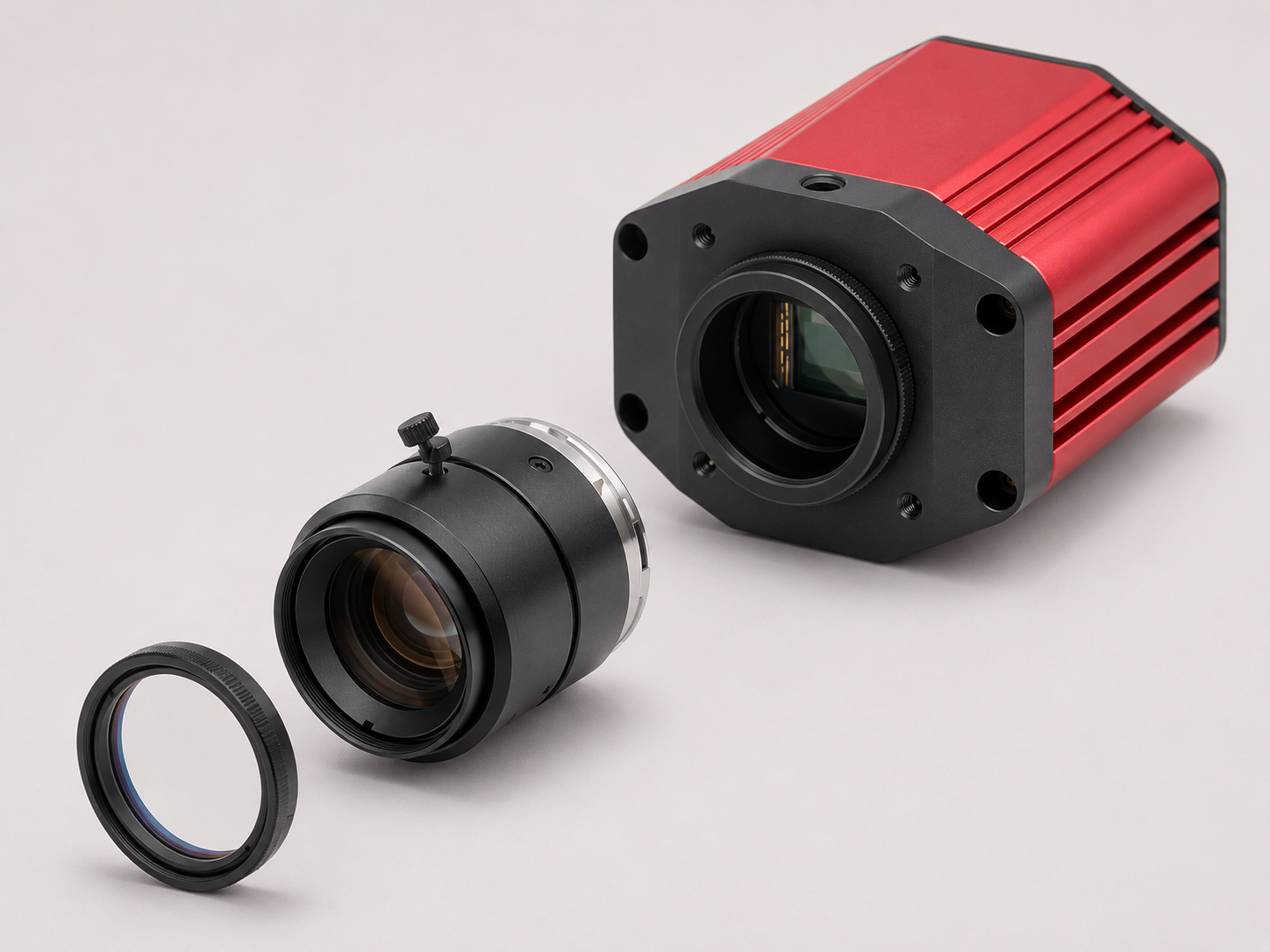 PB01 · IMAGE PENDINGBandpass filters in front of an industrial camera lens
Filters That Let Your Camera See Only Its Own Light
A vision system works best when the camera sees only the light it was designed for. A filter matched to your lighting removes the rest.
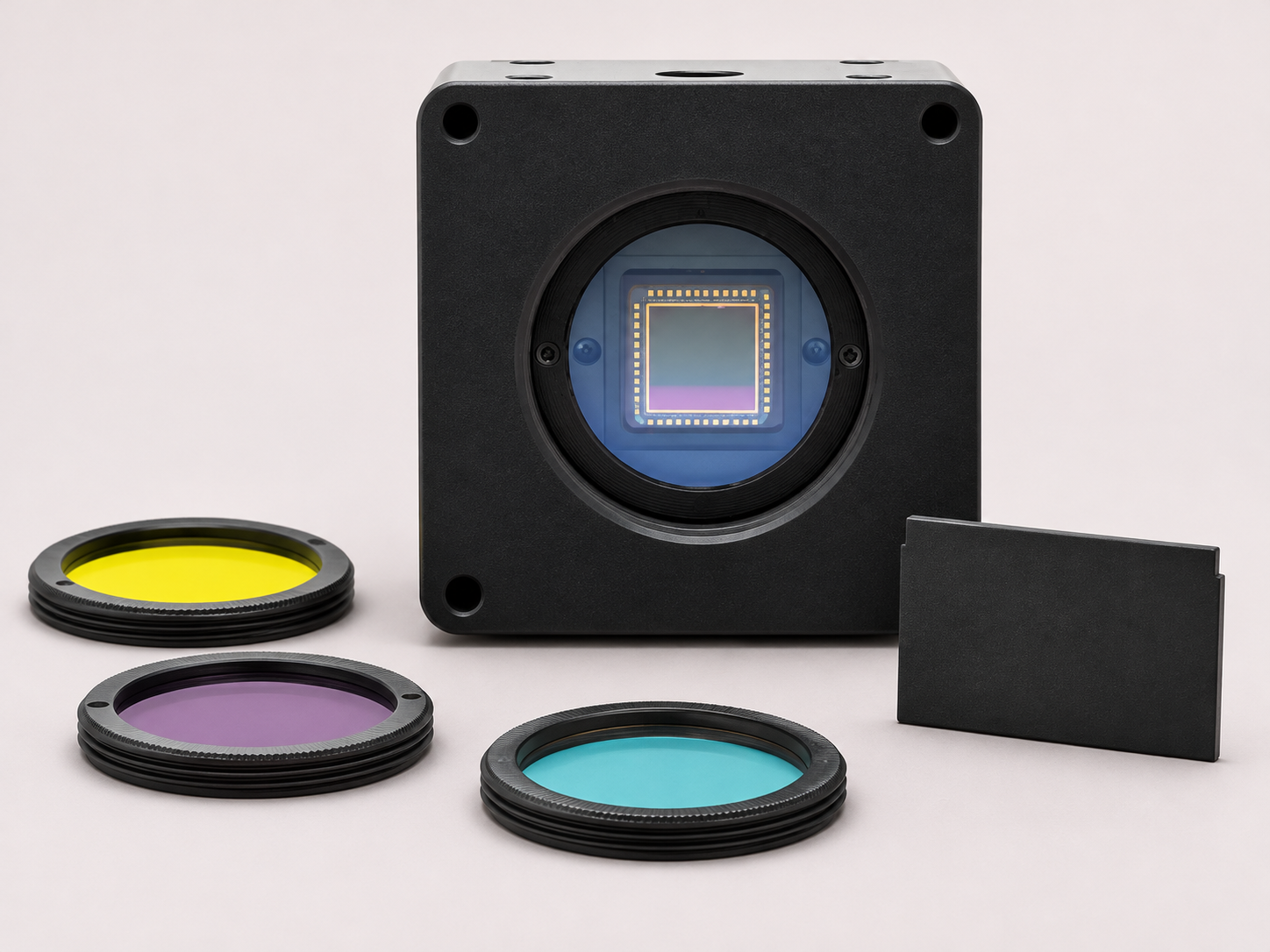
We make bandpass, dual-band, longpass, shortpass and neutral density filters for vision cameras, from the UV to the near-infrared.
Our standard bandpass filters cover the common LED colors, from 405 nm blue to 940 nm infrared, typically 20 to 60 nm wide.
Filters are cut to your lens thread, mount or drawing, with optional AR coating to reduce reflections.
Our machine vision filters are built for factory conditions: operating from −192 °C to +500 °C, environmentally tested to MIL-SPEC, with surface quality to 20-10 scratch-dig and λ/10 transmitted wavefront, in custom sizes up to 300 mm.
Need a band or size we do not list? Specify a custom filter
Why Add a Filter
Ambient light. Factory lights, sunlight through windows and nearby stations all reach the camera. A bandpass filter matched to your LED keeps your light and blocks theirs, so the image stays the same all day.
Contrast. Lighting a part in one color and filtering for it makes defects, labels and edges stand out against the background.
Separation. When one camera works with two light sources, or two cameras share a scene, filters let each see only its own light.
Choosing by Lighting
Single-color LED. Use a bandpass filter centered on the LED, wide enough to pass its whole emission. LEDs are typically 20 to 40 nm wide, so filters of 30 to 60 nm are a common match.
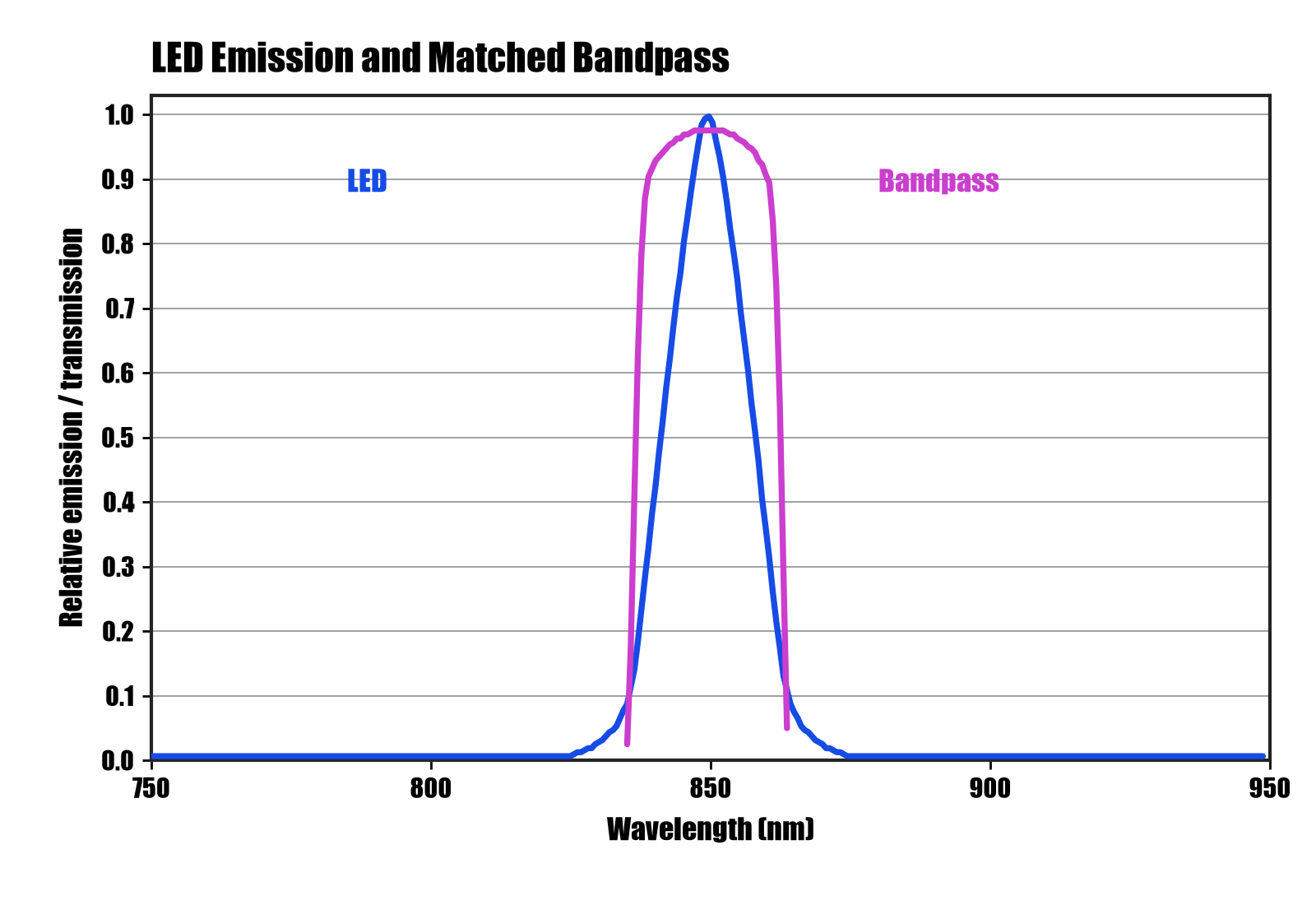 D01 · IMAGE PENDINGLED emission with a matched bandpass filter
Near-infrared LED. 850 and 940 nm lighting is invisible to operators and less affected by part color. A bandpass filter at the LED also removes all visible room light.
Color cameras. A shortpass filter that cuts infrared keeps colors true; IR690,OD3 passes 400 to 680 nm and blocks to 1,100 nm. ir690 od3
UV inspection. Under 365 nm lighting, a longpass filter blocks the UV and passes the visible glow of inks, glues or coatings. View details
 D02 · IMAGE PENDINGDual-band filter for day and night imaging
Day and night. A dual-band filter passes visible light and one infrared line, such as 850 or 940 nm, so one camera works in daylight and under infrared lighting. View details
Standard Filters by LED Color
| LED | Common peak (nm) | Standard filters |
|---|---|---|
| Violet | 405 | BP405-30,OD3 |
| Blue | 450 | BP450-60,OD3, BPF450-30,OD6 |
| Green | 520–530 | BP532-40,OD6 |
| Amber | 590 | BPF590-50,OD6 |
| Red | 620–630 | BPF630-30,OD6 |
| Deep red | 660 | BPF660-40,OD6 |
| Near-infrared | 850 | BPF850-30,OD3 |
| Near-infrared | 940 | BPF940-55,OD3 |
| Red + NIR | 650 + 850 | Multi-650/850 |
Each filter’s page has full specifications. For other wavelengths and widths, see all our bandpass filters. View details
Lenses and angle. Light through an interference filter shifts to shorter wavelengths as the angle grows. As a rule of thumb, a 20 nm bandpass filter in front of the lens stays on target to about 15°, roughly f/1.9; narrower filters accept less. With wide-angle lenses, choose a wider filter or tell us your field of view. View details
Where Our Filters Are Used
- Inspection under single-color LED lighting
- Barcode and label reading
- Infrared-lit inspection at 850 and 940 nm
- Day-and-night cameras
- UV fluorescence inspection of inks and glues
- Coaxial camera positioning on laser markers
- Light control with absorptive ND filters
What to Send Us
- LED or light source wavelength
- Camera: monochrome or color
- Lens focal length or field of view
- Filter size, thread or mount
- Any surface or flatness requirement
Setting up a vision station? Send us your light source, camera and lens, and we will recommend a filter, cut it to your size and send a quote. Contact us