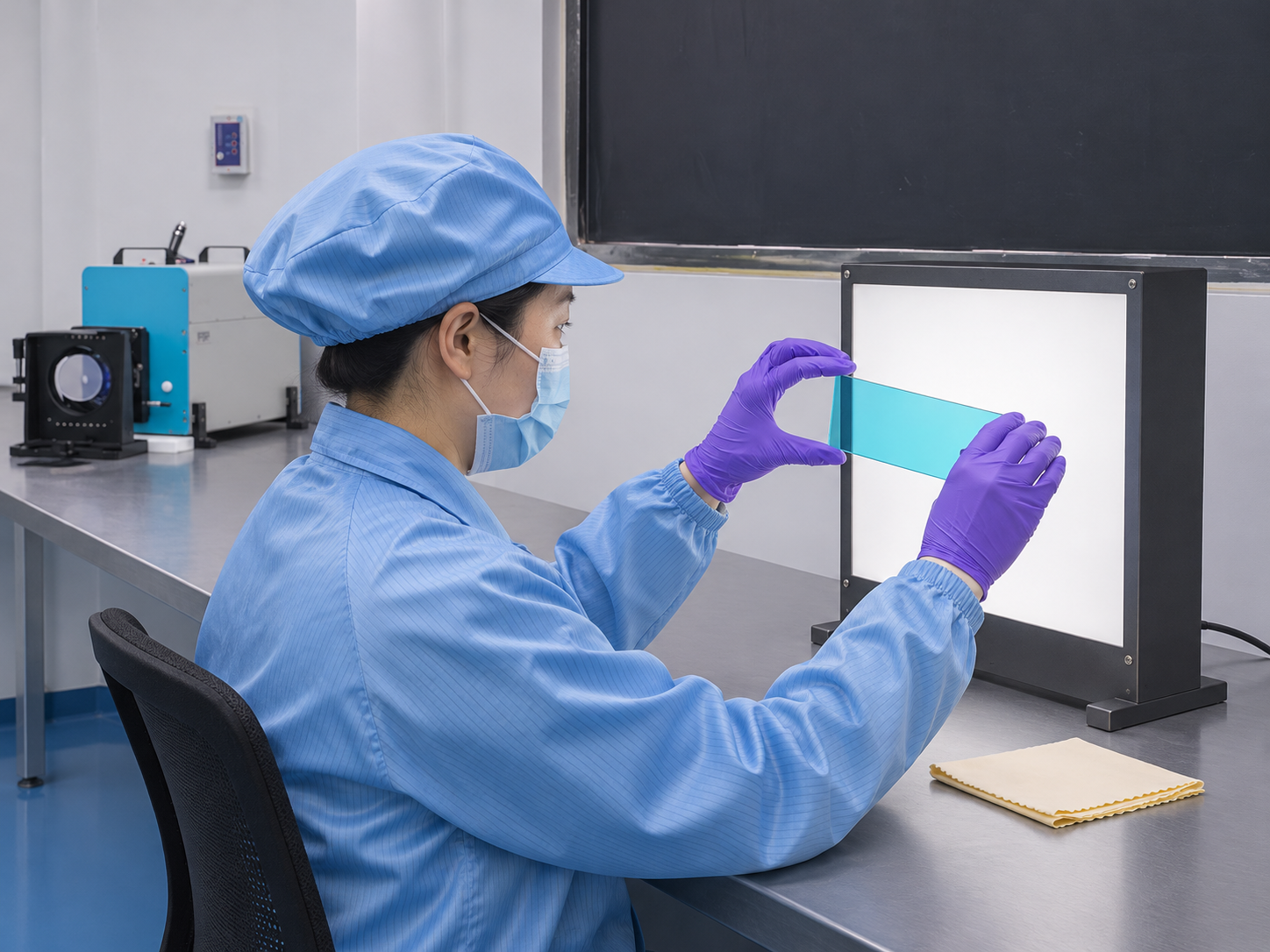
 PB01 · IMAGE PENDINGCustom optical filters being inspected
Custom Optical Filters
Your band, your blocking, your angle and your size
When no standard filter fits, we design and make one to your specification. Custom work usually starts from one of five needs: a spectral target no standard filter covers, a particular angle or polarization, a harsh environment, a size or shape that has to fit your housing, or a filter that has to match a specific source or detector. We handle the whole part in-house, from glass to coating to test, and every custom filter is measured before it ships.

What We Can Make
Center wavelengths from 200 to 2,500 nm and bandwidths from 3 to 250 nm, with blocking from OD2 to OD6. Filters are cut to your drawing, typically 0.3 to 3.0 mm thick, on the glass that suits the job: fused silica, sapphire, borosilicate or optical glass. We can add retaining rings, a back-side AR coating, conductive films with a set sheet resistance, ITO, anti-fog or water-repellent layers, and shape a filter’s response to match your light source or detector.
What You Can Specify

Band
Center wavelength and width, or cut-on and cut-off for edge filters. Several bands in one filter are possible.

Blocking
How deep, from OD2 to OD6, and over what range. Tell us your detector so we block everything it can see.

Angle and Polarization
0°, 45° or any design angle, the cone of light, and s, p or unpolarized. Filters shift with angle, so we design for yours. Learn more

Size, Shape and Material
Round, square or to your outline, 0.3 to 3.0 mm thick, on the substrate you choose, mounted or unmounted. Learn more
Environment
Operating temperature, humidity, cleaning and laser power. Wavelength drifts with temperature, so give us the range it will see.
Matched Response
Filters shaped to a light source or detector, so the system response follows a target curve.
How a Custom Project Runs
- Agree on the requirements
- Review what drives cost and difficulty
- Coat and measure prototypes
- Adjust if needed
- Lock the design for production
We start by agreeing on the spectrum, passband and blocking, angle and polarization, environment and size, and on how performance will be measured, so both sides test the same thing.
Before quoting, we look at what drives cost and risk in your spec. Often one tolerance or one blocking band sets the price, and a small change there can save real cost. We will tell you where that is.
We then coat a prototype run and measure it on our Cary 5000, or on the Cary 7000 for angle and polarization. If the first run misses a target, we adjust the design and coat again.
Once you approve the prototypes, the same design, materials and test plan carry into production, with batch records for every run. How we test
Engineering Support From the First Sketch
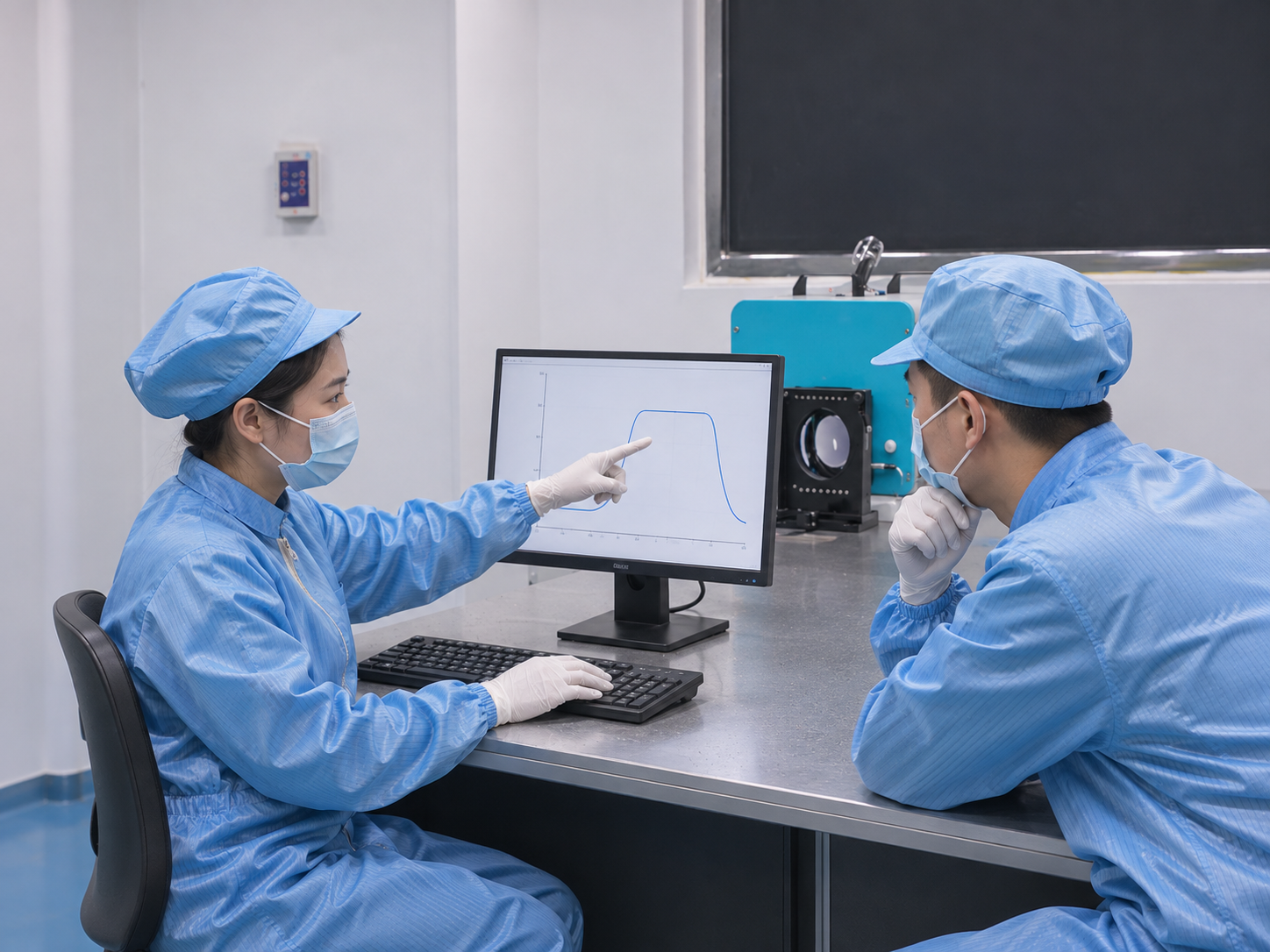
We start by agreeing on the spectrum, angle, environment and size, and on how performance will be measured. Before quoting, we check what drives cost and difficulty in your spec and suggest where a small change saves time.
You do not need a finished specification to start. Send us a rough idea, a competitor’s part number or a target curve, and our engineers will help turn it into numbers that can be made and tested.
We design the coating, model how it behaves at your angle and temperature, and check it against the glass and the process before anything is coated. A coating design engineer works with you on every custom project.
From Prototype to Production
Prototypes
Prototype runs start from 10 pieces, and each prototype comes with its measured spectrum.
Production
Production orders scale to 10,000 pieces and beyond. One coating run holds many filters, so a design moves from prototype to volume without changing process.
Long-term supply
For instrument makers we hold the design, the glass and the test plan for repeat orders, so the filter you buy next year matches the one you approved. We supply instrument makers in LiDAR, biomedical diagnostics, machine vision, aerospace and defense.
Confidentiality and documents
We work under NDA when you need it, and can supply certificates of conformance, first-article reports and test data in your format.
Get Started
Send Us Your Spec
Fill in the form below, or attach a drawing or target curve.
Start From a Standard Filter
Find the closest standard filter, then ask us to adjust it. View details
Custom Filter Request
We reply within one working day.
Local preview only. No inquiry or attachment is sent until a server-side form endpoint is connected.
We reply within one working day.
Custom Filter FAQs
What counts as a custom filter?
Any filter built to your specification rather than taken from stock: a new band, a different blocking range, an unusual angle, size or substrate, or a filter matched to your source or detector.
Can you make prototypes and then production volumes?
Yes. The prototypes prove the design and fix the process; production uses the same design, glass and test plan.
What information do you need for a quote?
The target spectrum and how it will be measured, the angle of incidence and polarization, the substrate and size, the operating environment, the quantities for prototype and production, and any standards or documents you need. A drawing helps.
Can you coat substrates we supply?
Yes, after we confirm the material and how the parts are cleaned.
Will I get measured data?
Yes. Every custom filter is measured, and the prototype run comes with its measured spectrum. Learn more
Can you test at our operating temperature?
Narrow filters shift with temperature, so tell us the range. We design for the shift, and can test filters at controlled temperatures from −192 °C to +500 °C, including cryogenic testing to 77 K.
Do you sign NDAs?
Yes. Send us your NDA with the request.
Prefer to Talk First?
Email our engineers with a rough idea; we will help turn it into a specification you can quote and test. Contact us
Email or call our engineers with a rough idea. We will help turn it into a specification you can quote and test.