
Astronomy Narrowband Filters
H-alpha, OIII and SII, 3 to 10 nm wide
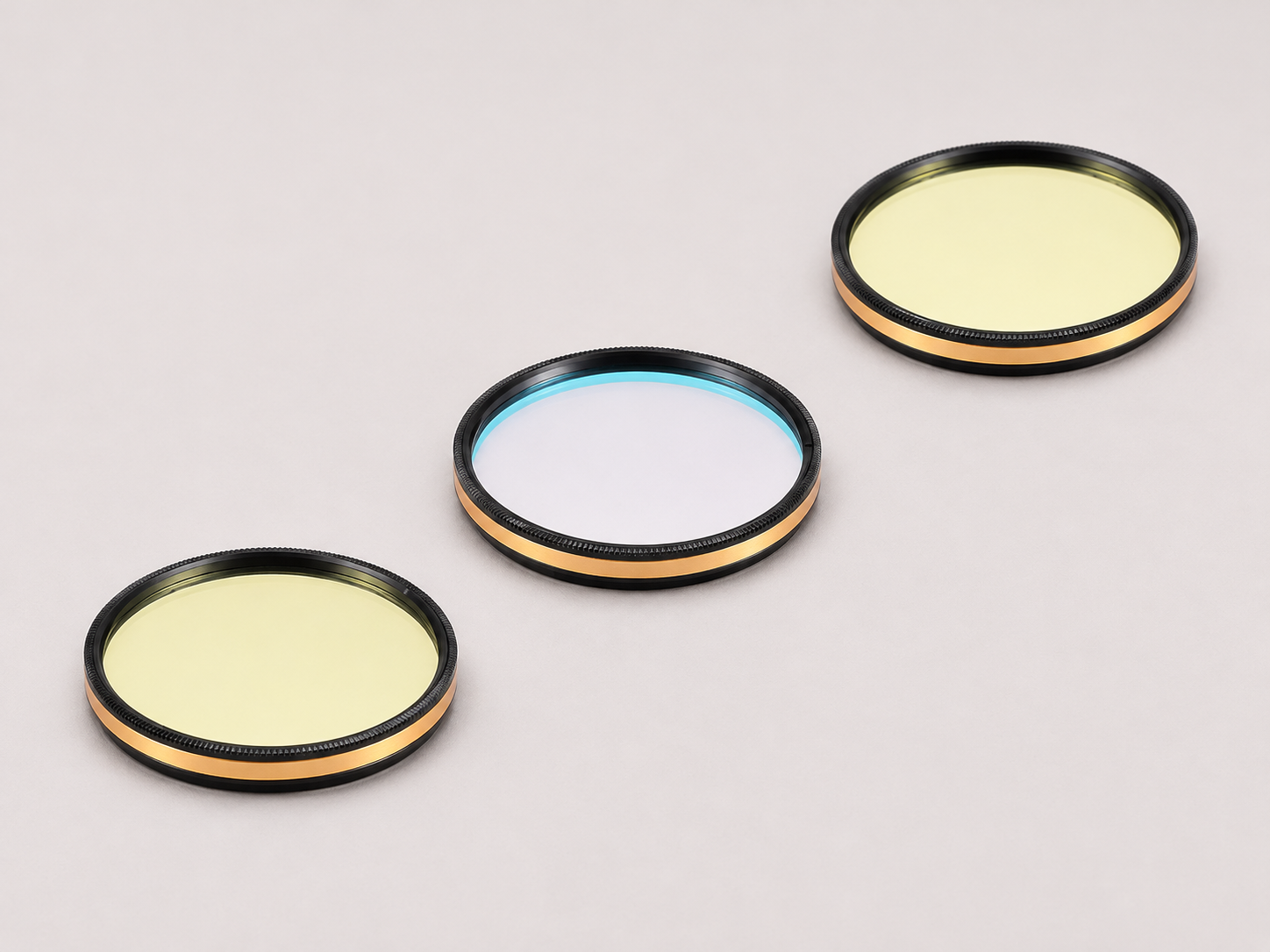 PB01 · IMAGE PENDINGH-alpha, OIII and SII narrowband filters
Emission-Line Filters for Astrophotography and Observing
Many nebulae shine at a few sharp wavelengths. A narrowband filter passes those lines and blocks skyglow, so faint structure stands out against a dark background.
We make narrowband filters for H-alpha at 656.3 nm, OIII at 500.7 nm and SII at 672 nm, 3 to 10 nm wide.
Peak transmission is 90% or more, with average blocking of OD4 or better outside the band.
We also make dual narrowband filters that pass OIII and H-alpha together, for color cameras.
We also make complete photometric sets: Johnson/Bessell and Kron/Cousins UBVRI, Sloan u, g, r, i and z, near-infrared J, H and K, and LRGB imaging sets, with λ/4 per inch transmitted wavefront and 30 arc-second parallelism.

Filters are cut to your size, with optional mounting rings. Specify a custom astronomy filter
What an Emission-Line Filter Does
Light pollution, moonlight and airglow spread across the whole spectrum. Hydrogen, oxygen and sulfur in a nebula emit at single wavelengths. A filter a few nanometres wide keeps nearly all of the target’s light and very little of the sky’s.
Monochrome cameras typically shoot SII, H-alpha and OIII separately and combine them into one color image.
Color cameras use a dual narrowband filter to record H-alpha and OIII in one exposure.
 D01 · IMAGE PENDINGLight pollution spectrum with SII, H-alpha and OIII lines
Choosing the Bandwidth
Narrower filters give more contrast. A 3 nm filter passes less skyglow than a 7 nm one, which helps under bright city skies and moonlight.
Narrower filters also demand more of your optics. They tolerate less angle, so they suit slower telescopes best.
For dual narrowband filters, the same trade-off applies to each band.
Tell us your telescope’s focal ratio and your sky, and we will suggest a width between 3 and 10 nm.
Wider filters, around 7 to 10 nm, are more forgiving with fast optics and keep stars brighter, at the cost of some contrast.
 D03 · IMAGE PENDINGH-alpha passband shift at f/4 and f/2
The OIII, H-alpha and SII passbands shift toward shorter wavelengths as the light enters at larger angles in faster optical systems.
Fast Telescopes and Wavelength Shift
In a fast telescope, light reaches the filter as a steep cone. The steeper the cone, the further an interference filter’s passband moves to shorter wavelengths.
Using the standard formula, an H-alpha filter at f/4 shifts by roughly 0.6 to 1.2 nm. At f/2, the shift grows to roughly 2 to 5 nm, enough to pull a 3 nm filter off the line.
For very fast systems, we can design the filter with its center set slightly longer, so it lands on the line in your light cone. Angle shift explained
Narrowband Astronomy Filter Designs
| Design | Line | CWL (nm) | FWHM (nm) | Peak T | Blocking |
|---|---|---|---|---|---|
| SII | Ionized sulfur | 672 | 3–10 | ≥ 90% | OD avg ≥ 4 |
| H-Alpha | Hydrogen | 656.3 | 3–10 | ≥ 90% | OD avg ≥ 4 |
| OIII | Doubly ionized oxygen | 500.7 | 3–10 | ≥ 90% | OD avg ≥ 4 |
Bandwidth, size and mounting are set to your order. Dual narrowband and other emission lines are available on request.
Who We Make Them For
- Astronomy filter brands and distributors
- Astronomical camera and telescope makers
- Observatories and research instruments
What to Send Us
- Lines needed: SII, H-alpha, OIII or dual
- Bandwidth, or let us suggest one
- Telescope focal ratio
- Filter size and thickness
- Mounting ring or unmounted
- Quantity
Building a filter line or an astronomy camera? Send us your lines, bandwidth, focal ratio and size, and we will quote coated filters, mounted or unmounted. Contact us