
Longpass Filters
Longpass Filters with Cut-On from 235 to 1,755 nm
When the light you want is at longer wavelengths than the light you need to get rid of, such as fluorescence above its excitation or near-infrared behind visible glare, a longpass filter blocks everything below its cut-on and passes everything above it.
We make standard longpass filters with cut-on edges from 235 to 1,755 nm, transmitting out to 1,100 nm and, for SWIR work, as far as 2,500 nm.
You can choose deep blocking, specified as OD3 to OD6, or a lower-cost reflective edge that reflects more than 99% of the light below it.
When the light to block sits right next to your signal, our ultra-steep filters go from blocking to full transmission within 10 to 20 nm.
Standard magnetron-sputtered longpass filters block to OD4 or better, with a cut-on slope of 6% or less and more than 85% average transmission; steep-edge versions reach a slope of 1% or less with at least 91% transmission and operate from −50 °C to +200 °C.

For other cut-on wavelengths, we coat custom longpass filters from 300 to 2,500 nm. Specify a custom filter
How to Read a Longpass Spec
The cut-on wavelength is the edge, usually defined at 50% of peak transmission. For example, a 1,000 nm longpass might cut on at 1,000 ± 2 nm, block above OD6 from 350 to 995 nm, and pass more than 98% on average from 1,005 to 2,000 nm.
The two band limits matter more than the cut-on itself. The gap between where blocking ends and where full transmission begins is the transition width: 10 nm on that example, 50 nm on a standard OD6 filter at 950 nm.
Check both ends of the pass band too. Many visible longpass filters are only specified to 1,100 nm; if your detector reaches further into the infrared, choose one specified out to 1,700 nm or beyond.
Three Types of Longpass Filter
 D01 · IMAGE PENDINGStandard longpass edge
OD-Blocked Longpass
Blocking specified as optical density across a stated range, OD3 to OD6. Available with edges from the UV to the near-infrared, and in the SWIR out to 2,100–2,500 nm. Choose these when you need a guaranteed blocking depth.
 D02 · IMAGE PENDINGUltra-steep longpass edge
Reflective-Edge Longpass
Edges from 235 to 920 nm. They reflect more than 99% of the light below the edge and pass 90 to 98% above it, out to 1,100 nm. A practical choice for removing UV or a shorter visible band.
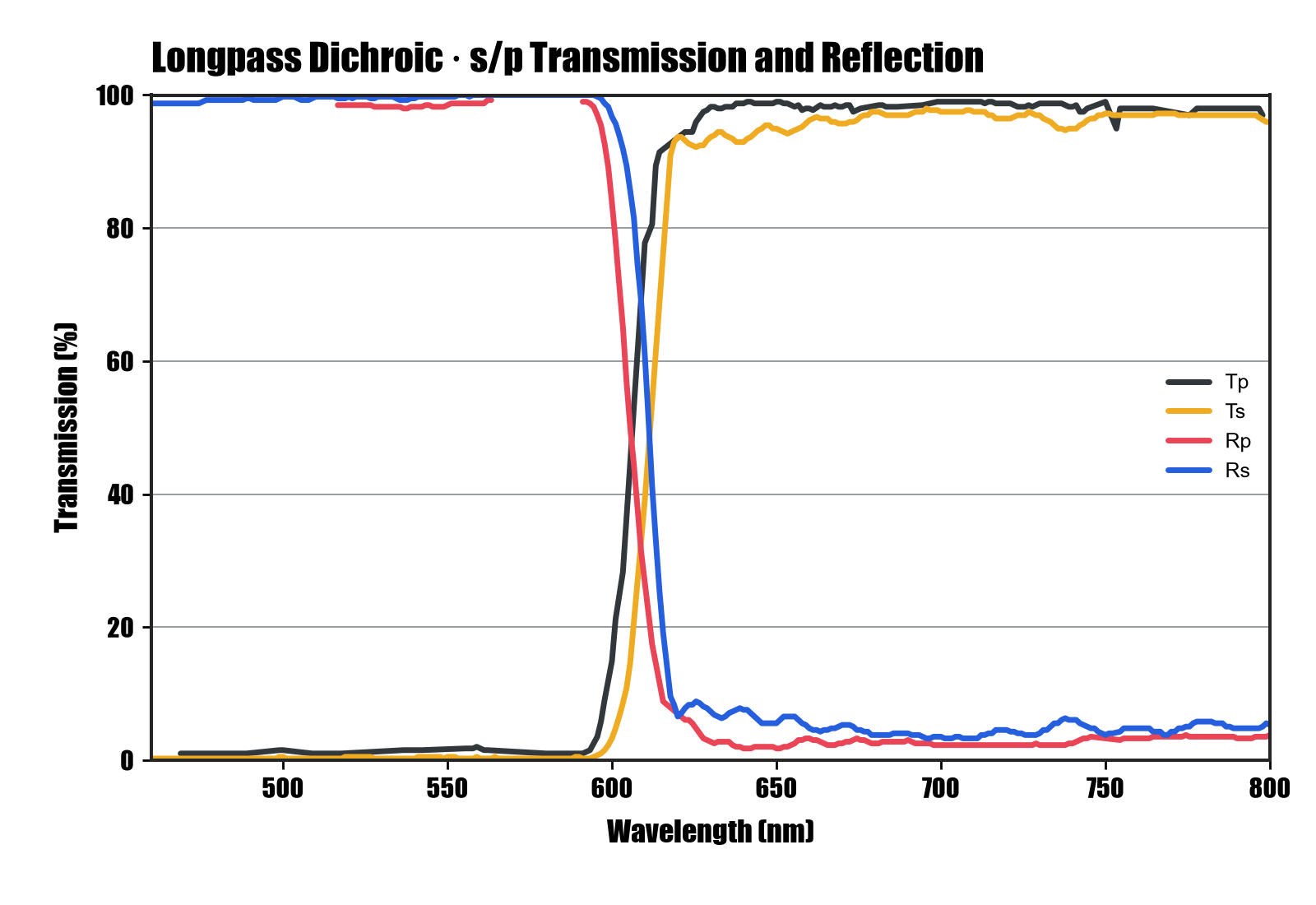 D03 · IMAGE PENDINGReflective longpass edge
Ultra-Steep Longpass
Edges at 1,000, 1,140, 1,200 and 1,300 nm that go from blocking to full transmission within 10 to 20 nm, with OD3 to OD6 blocking and transmission up to 2,100 nm. Use them when the light to block sits close to your signal.
The comparison shows how edge steepness and blocking depth describe different parts of longpass filter performance.
Steepness and Depth Are Different Things
A reflective-edge filter that reflects 99% can still transmit up to 1% below its edge, which is at most OD2. An OD6 filter transmits 0.0001%. When the light you are blocking is much stronger than your signal, specify OD, not reflectance.
Edge steepness also depends on how deep you measure it. A reflective edge reaches R > 99% within 10 to 40 nm of full transmission. An ultra-steep filter reaches OD3 to OD6 within 10 to 20 nm, while a standard OD-blocked filter needs 35 to 75 nm.
Tilting a longpass filter moves its cut-on to shorter wavelengths, so a small tilt can fine-tune the edge. Fix the angle in your design and tell us what it is.
Choosing a Longpass Filter
Work from the two wavelengths that matter: the longest one you must block and the shortest one you must keep.
- Gap under 20 nm: choose an ultra-steep filter
- Gap of 35 nm or more: a standard filter works
- Strong source to block: specify OD, not reflectance
- Detector beyond 1,100 nm: check the pass-band end
- Fixed tilt in the system: tell us the angle
- Hot or cold environment: give the temperature range
Related Filter Types
- Shortpass filters Learn more
- Notch filters for a single laser line Learn more
- Dichroic mirrors for 45° beam splitting Learn more
- IPL filters for cosmetic light sources Learn more
- How to read a filter spec Learn more
Standard Longpass Filters
| Model | Cut-on (nm) | Pass band (nm) | Transmission | Blocking | Blocking band (nm) | Type |
|---|---|---|---|---|---|---|
| LP380,OD4 | 380 ± 2 | 385–1,100 | > 92% (abs) | OD4 | 200–385 | Standard |
| LPF235 | — | 245–1,100 | > 90% (abs) | R > 99% | 200–230 | Reflective edge |
| LPF370 | — | 380–1,100 | > 90% (abs) | R > 99% | 350–360 | Reflective edge |
| LPF400 | — | 400–1,100 | > 90% (abs) | R > 99% | 350–385 | Reflective edge |
| LPF500 | — | 510–1,100 | > 90% (abs) | R > 99% | 350–490 | Reflective edge |
| LPF600 | — | 605–1,100 | > 90% (abs) | R > 99% | 350–595 | Reflective edge |
| IPL640nm | — | 650–1,100 | > 92% (abs) | R > 98% | 200–630 | IPL |
| LPF700 | — | 705–1,100 | > 92% (abs) | R > 99% | 350–695 | Reflective edge |
| LPF760 | — | 780–1,100 | > 90% (avg) | R > 99% | 350–740 | Reflective edge |
| LP780,OD4 | 780 ± 5 | 785–1,100 | > 92% (abs) | OD4 | 350–750 | Standard |
| LPF805 | — | 810–1,100 | > 95% (avg) | R > 99% | 350–800 | Reflective edge |
| LPF890 | — | 900–1,100 | > 95% (abs) | R > 99% | 350–880 | Reflective edge |
| IPL900nm | — | 910–1,800 | > 92% (abs) | R > 98% | 200–880 | IPL |
| LPF920 | — | 930–1,100 | > 98% (abs) | R > 99% | 350–900 | Reflective edge |
| LP950,OD6 | 950 ± 7.5 | 960–1,100 | > 95% (abs) | OD6 | 350–910 | Standard |
| LPF1000 (Ultra-Steep) | 1,000 ± 2 | 1,005–2,000 | > 98% (avg) | OD6 | 350–995 | Ultra-steep |
| LPF1140 (Ultra-Steep) | 1,140 ± 2 | 1,150–1,700 | > 92% (avg) | OD3 | 350–1,130 | Ultra-steep |
| LPF1200 (Ultra-Steep) | 1,200 ± 2 | 1,205–2,100 | > 92% (avg) | OD3 | 350–1,195 | Ultra-steep |
| LPF1300 (Ultra-Steep) | 1,300 ± 2 | 1,310–1,750 | > 98% (avg) | OD3 | 700–1,290 | Ultra-steep |
| LP1660 | 1,660 ± 2 | 1,700–2,500 | > 92% (avg) | OD3 | 200–1,625 | Standard |
| LPF1755 | 1,755 ± 2 | 1,790–2,100 | > 92% (avg) | OD3 | 350–1,725 | Standard |
abs: absolute transmission across the band; avg: average transmission. We have about 60 more standard longpass designs, with cut-on from 335 to 1,200 nm. Get the full list
Need a different edge? Send us the longest wavelength to block and how deep, the shortest wavelength to keep, the pass-band end, angle of incidence and operating temperature, and we will reply with a quote and a recommended design. Contact us