
Shortpass Filters
Shortpass Filters with Cut-Off from 490 to 1,530 nm
When unwanted light sits at longer wavelengths than your signal, such as near-infrared on a camera sensor or the laser in a multiphoton microscope, a shortpass filter passes everything below its cut-off and blocks what lies above.
We make standard shortpass filters with edges from 490 to 1,530 nm. Most pass more than 90% from 400 or 450 nm up to the edge.
Above the edge they block to OD2–OD6, out to 1,100 nm and, on some designs, 1,500 or 1,800 nm.
Many are built for multiphoton microscopes, where they pass the fluorescence and hold back a near-infrared femtosecond laser.
Standard shortpass filters use a quarter-wave stack from 400 to 1,000 nm, with a cut-off slope of 6% or less, on BK7 or fused silica in standard sizes.

Need another edge? Ask us for a custom shortpass design. Specify a custom filter
Three Kinds of Shortpass Filter

IR-Cut and Visible Pass
Keeps near-infrared light off a silicon camera sensor: for example, more than 95% transmission from 400 to 680 nm and OD3 blocking from 712 to 1,100 nm.
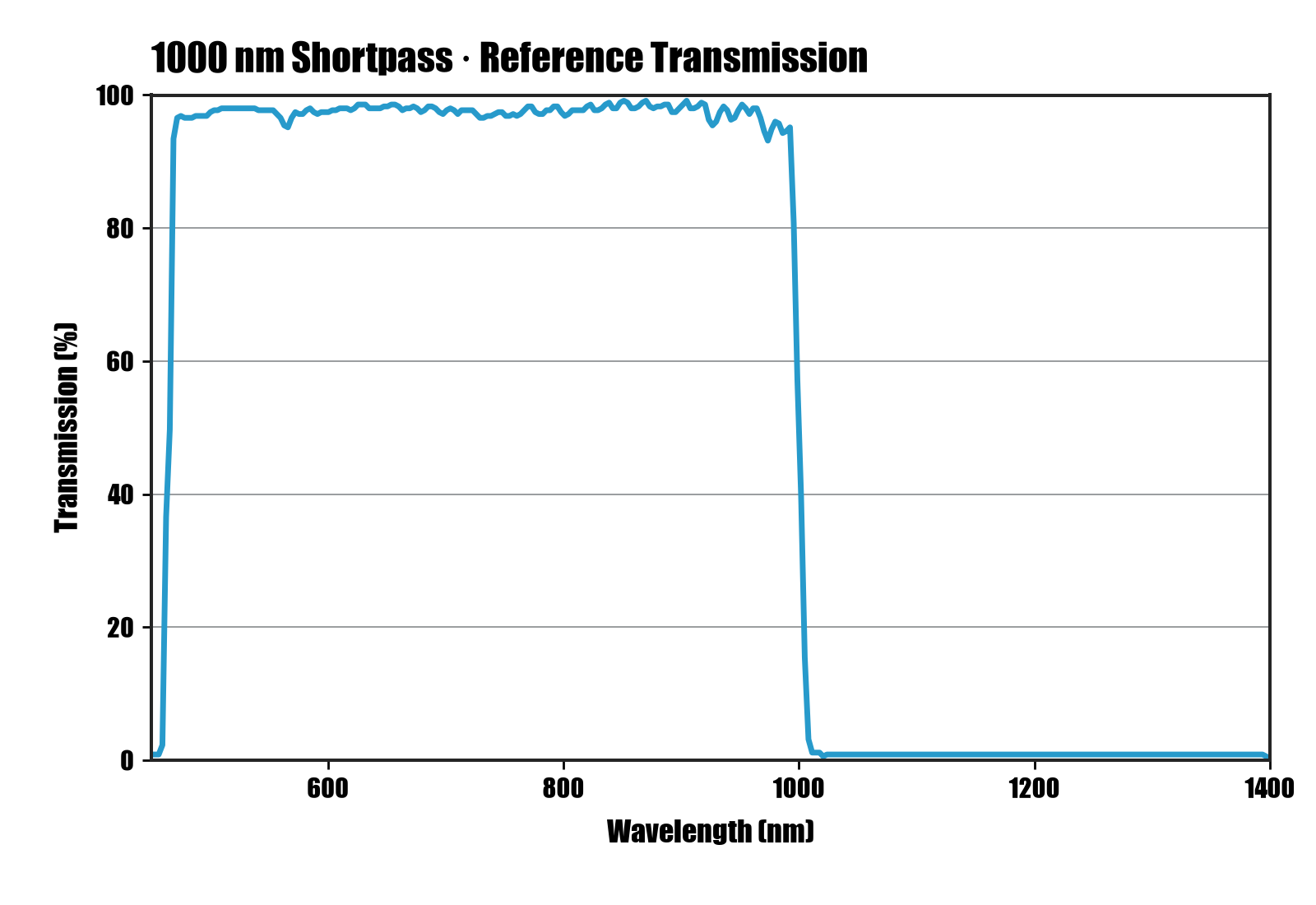 D01 · IMAGE PENDINGNIR and SWIR shortpass curves
The 1000 nm shortpass curve transmits shorter wavelengths and blocks light beyond the cut-off.
NIR and SWIR Edges
Edges in the near-infrared and SWIR, such as 980 nm and 1,530 nm, both blocked at OD4. The 1,530 nm edge goes from transmission to blocking in just 10 nm.
 D02 · IMAGE PENDINGLight path for multiphoton emission collection
Multiphoton Emission
Edges from 490 to 1,530 nm that pass the fluorescence and block the excitation laser, which in most multiphoton microscopes runs between 700 and 1,000 nm. Multiphoton filters
What to Check Before You Choose
Does the blocking band cover your source? The blocking range must reach past the longest wavelength you need to remove. Our standard filters block to 1,100, 1,500 or 1,800 nm; a laser beyond that range is not covered.
Is it deep enough? OD2 lets 1% of the light through, OD6 one part in a million. A femtosecond excitation laser is far brighter than the fluorescence you collect, so our multiphoton shortpass filters block at OD6.
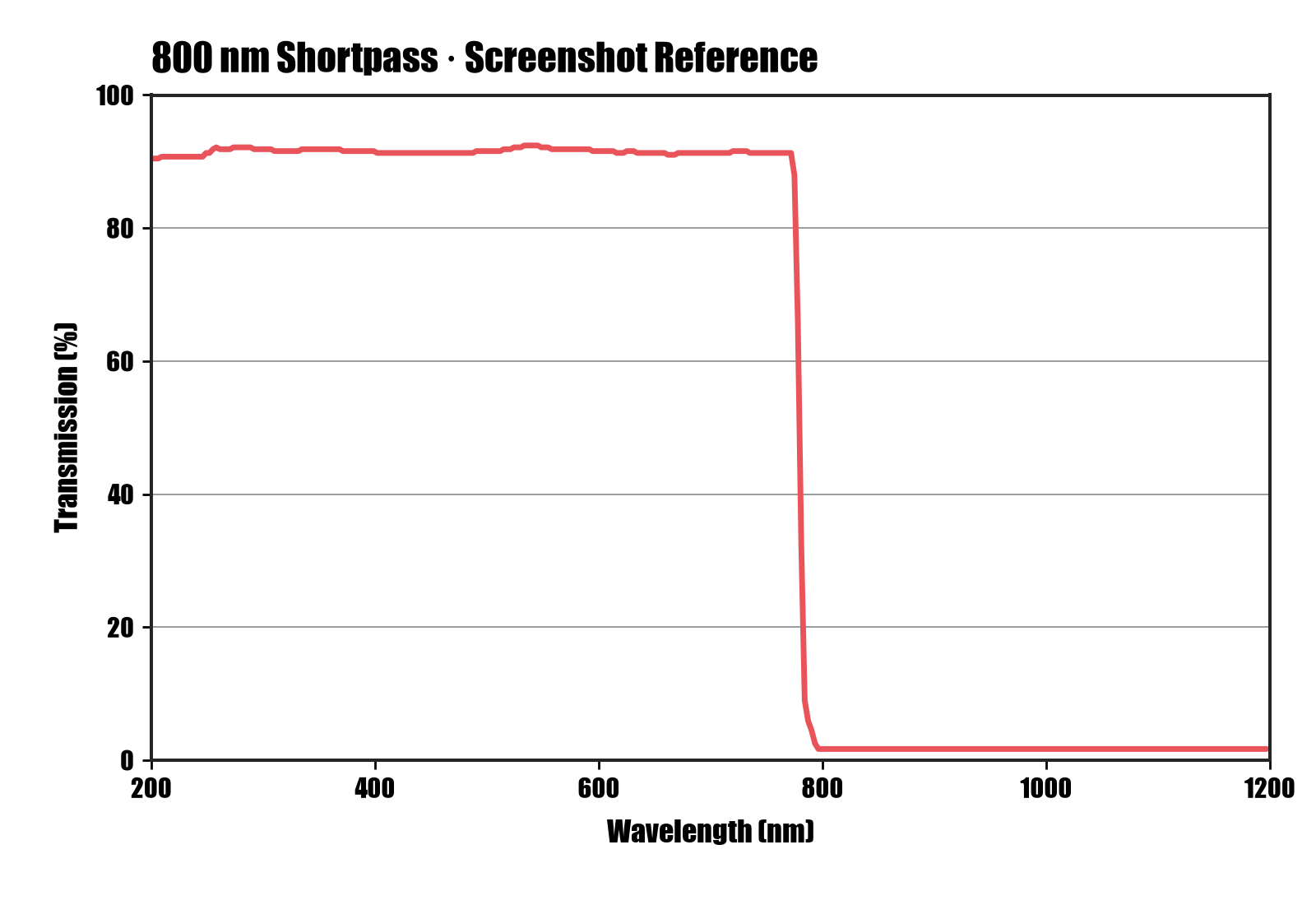 T01 · IMAGE PENDINGMeasured spectrum of Multiphoton SP800
The 800 nm shortpass curve shows high transmission below the cut-off and a sharp drop above it.
Is the OD measured or designed? Above 800 nm, spectrophotometer readings of deep blocking are limited by noise. Where we can’t measure that deep, we state the design value and mark it.
How sharp is the edge? From full transmission to blocking takes 10 to 50 nm, depending on the design: as little as 10 nm at 1,530 nm and 15 nm on our 800 nm multiphoton filter, 45 to 50 nm on visible edges at 650 to 700 nm.
Is the angle fixed? Like other edge filters, the cut-off moves to shorter wavelengths when tilted, so give us the angle in your design. Above 800 nm, our Cary 5000 reads down to about OD5 before it reaches its noise floor.
What to Specify for a Shortpass Filter
Have these ready when you ask for a quote. If you are unsure of some, tell us about your system and we will help fill them in:
- Shortest and longest wavelength to transmit
- Shortest and longest wavelength to block
- Blocking OD needed at your source wavelength
- Your laser or IR source power, if known
- Angle of incidence and cone half-angle
- Operating temperature range
- Size, thickness and mounting
Related Filter Types
- Longpass filters Learn more
- Hot mirrors that reflect near-infrared Learn more
- Dichroic mirrors for 45° beam splitting Learn more
- Bandpass filters Learn more
Standard Shortpass Filters
| Model | Cut-off (nm) | Pass band (nm) | Transmission | Blocking | Blocking band (nm) | Type |
|---|---|---|---|---|---|---|
| Multiphoton SP490 | 490 ± 2 | 400–480 | > 90% (avg) | OD3 / OD2 (design) | 502–600 / 600–800 | Multiphoton |
| Multiphoton SP520 | 520 ± 2 | 400–510 | > 90% (avg) | OD2* | 530–1,100 | Multiphoton |
| Multiphoton SP650 | 650 ± 2 | 400–640 | > 90% (avg) | OD2* | 685–1,100 | Multiphoton |
| IR690,OD3 | 680 ± 5 | 400–680 | > 95% (abs) | OD3 | 712–1,100 | IR-cut |
| Multiphoton SP690 | 690 ± 2 | 400–670 | > 90% (avg) | OD2* | 720–1,100 | Multiphoton |
| Multiphoton SP700 | 700 ± 2 | 400–680 | > 90% (avg) | OD2* | 725–1,100 | Multiphoton |
| Multiphoton SP800 | — | 500–795 | > 90% (avg) | OD6* | 810–1,500 | Multiphoton |
| Multiphoton SP980 | — | 450–960 | > 90% (avg) | OD3* | 995–1,100 | Multiphoton |
| SP980,OD4 | 980 ± 2 | 450–970 | > 92% (abs) | OD4 | 1,000–1,100 | NIR |
| Multiphoton SP1530 | — | 900–1,510 | > 90% (avg) | OD6* | 1,540–1,800 | Multiphoton |
| SP1530,OD4 | 1,530 ± 2 | 900–1,525 | > 92% (abs) | OD4 | 1,535–1,800 | SWIR |
* Above 800 nm, OD readings are limited by measurement noise; these are design values. abs: absolute transmission across the band; avg: average transmission. We have about 29 more standard shortpass designs with cut-off from 500 to 910 nm. Get the full list
Need a different edge? Send us the band to transmit, the band to block and how deep, your source wavelength, angle of incidence and operating temperature, and we will reply with a quote and a recommended design. Contact us