
Fluorescence Microscopy Filters
Sets from DAPI to Cy5 on 25 mm optics
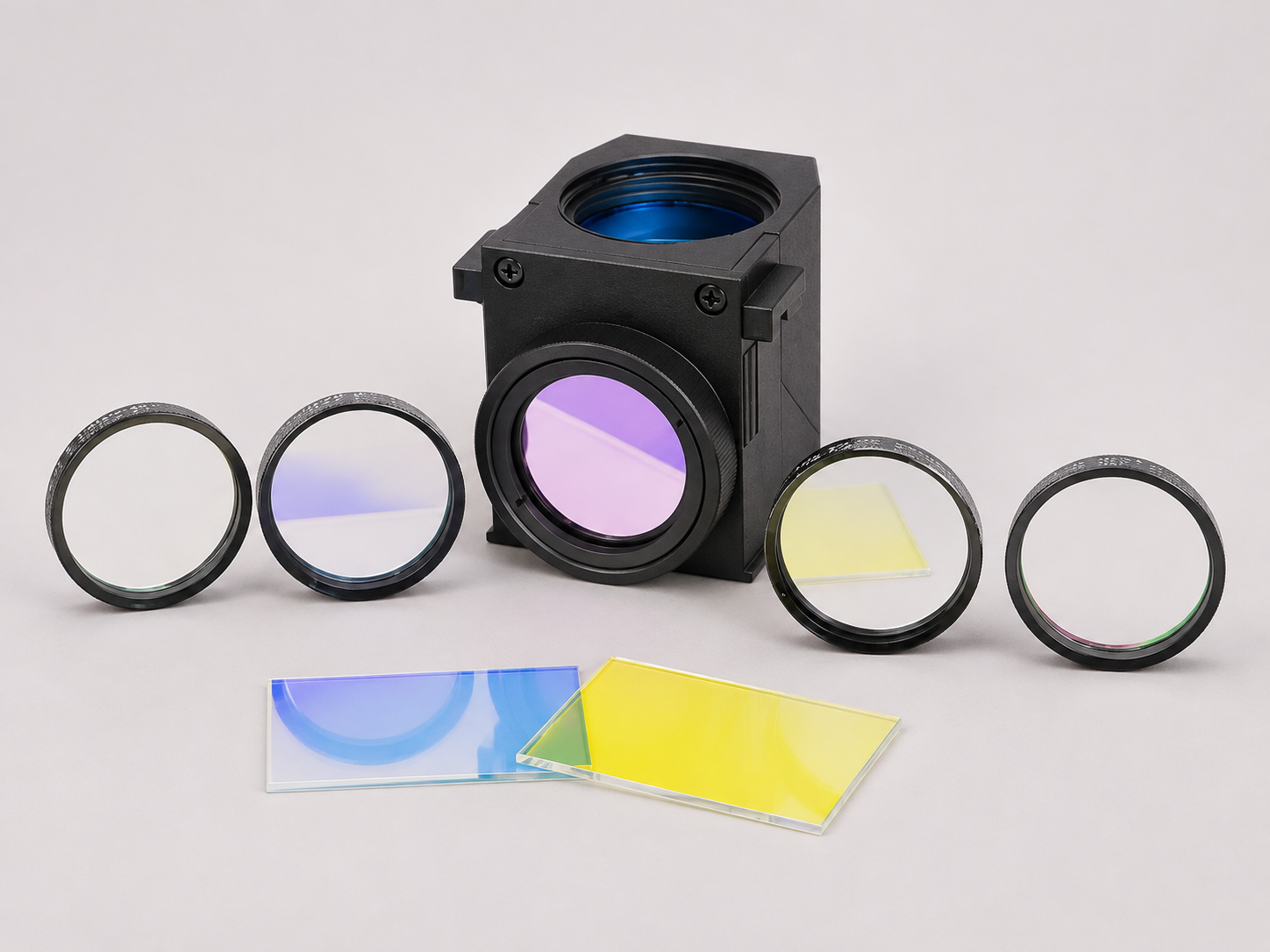 PB01 · IMAGE PENDINGFluorescence filter cube with three filters
Filter Sets for Widefield Fluorescence Microscopes, from DAPI to Cy5
A fluorescence microscope separates weak emitted light from bright excitation light with three filters: excitation, dichroic and emission.
We supply seven matched sets, from DAPI to Cy®5 and Alexa Fluor® 647, plus the single filters and dichroics to build your own.
Our microscopy filters transmit at least 90% on average and block at OD6 on average, with every point above OD5.
Standard filters are 25 mm in diameter, 3.5 or 5.0 mm thick with an alumina ring, and can be supplied fitted in filter cubes.
Custom centers from 350 to 850 nm and widths from 20 to 80 nm are available for other fluorophores. Specify a custom filter

Inside a Filter Cube
The excitation filter selects the light that excites the dye; the 45° dichroic reflects it to the sample and transmits the longer-wavelength emission; the emission filter removes what is left of the excitation light before the camera.
 D01 · IMAGE PENDINGEpi-fluorescence light path with FITC set wavelengths
Why Blocking Matters Most for Microscopy
The emission is many orders of magnitude weaker than the excitation light, so any excitation that leaks through becomes background in your image. Blocking is quoted two ways: the average OD across the band, and the lowest point.
Our microscopy filters are specified at OD6 on average and at least OD5 at every point. An average alone can hide a weak spot; a minimum makes sure there is none.
Also check where blocking stops. Cameras respond into the near-infrared, so excitation and emission filters must block light your lamp or LED emits there. Our microscopy filters block from 200 to 1,100 nm, across the full response of a silicon camera.
Microscopy Filters vs qPCR Filters
Many dyes are the same, but the filters differ. Microscopy filters are 25 mm round and up to 80 nm wide to collect as much light as possible from a broad lamp or LED; our qPCR filters are as small as 6 mm and 10 to 60 nm wide.
The emission filter sits in the imaging path, so its flatness and parallelism affect image sharpness and ghosting. Our microscopy emission filters are polished to λ/4 per inch transmitted wavefront and 30 arc-second parallelism.
If you are building a plate reader or qPCR module rather than a microscope, see our qPCR filters. qPCR filter guide
Choose a Set by Fluorophore
| Fluorophores | Excitation center (nm) | Emission center (nm) | Set |
|---|---|---|---|
| DAPI / Alexa Fluor® 350 | 375 | 460 | View Set |
| Atto 425 / ECFP / AmCyan | 430 | 480 | View Set |
| FITC / EGFP / Alexa Fluor® 488 (A) | 470 | 535 | View Set |
| FITC / EGFP / Alexa Fluor® 488 (B) | 480 | 535 | View Set |
| Cy®3 / TRITC / TAMRA | 530 | 605 | View Set |
| ROX / mCherry / Alexa Fluor® 594 | 560 | 635 | View Set |
| Cy®5 / Alexa Fluor® 647 | 624 | 694 | View Set |
The two FITC sets differ in the excitation filter: 470 nm, 40 nm wide (A) or 480 nm, 30 nm wide (B). Bandwidths and dichroics for every set are on the set pages. Alexa Fluor and Cy are trademarks of their respective owners.
What to Send Us
- Fluorophores, or excitation and emission wavelengths
- Light source: lamp, LED or laser
- Microscope make and model (for cubes)
- Filter size and thickness
- Single filters, sets or complete cubes
Imaging a fluorophore not listed here? Send us its excitation and emission peaks, your light source and camera, and we will suggest a matched set or design one. Contact us