
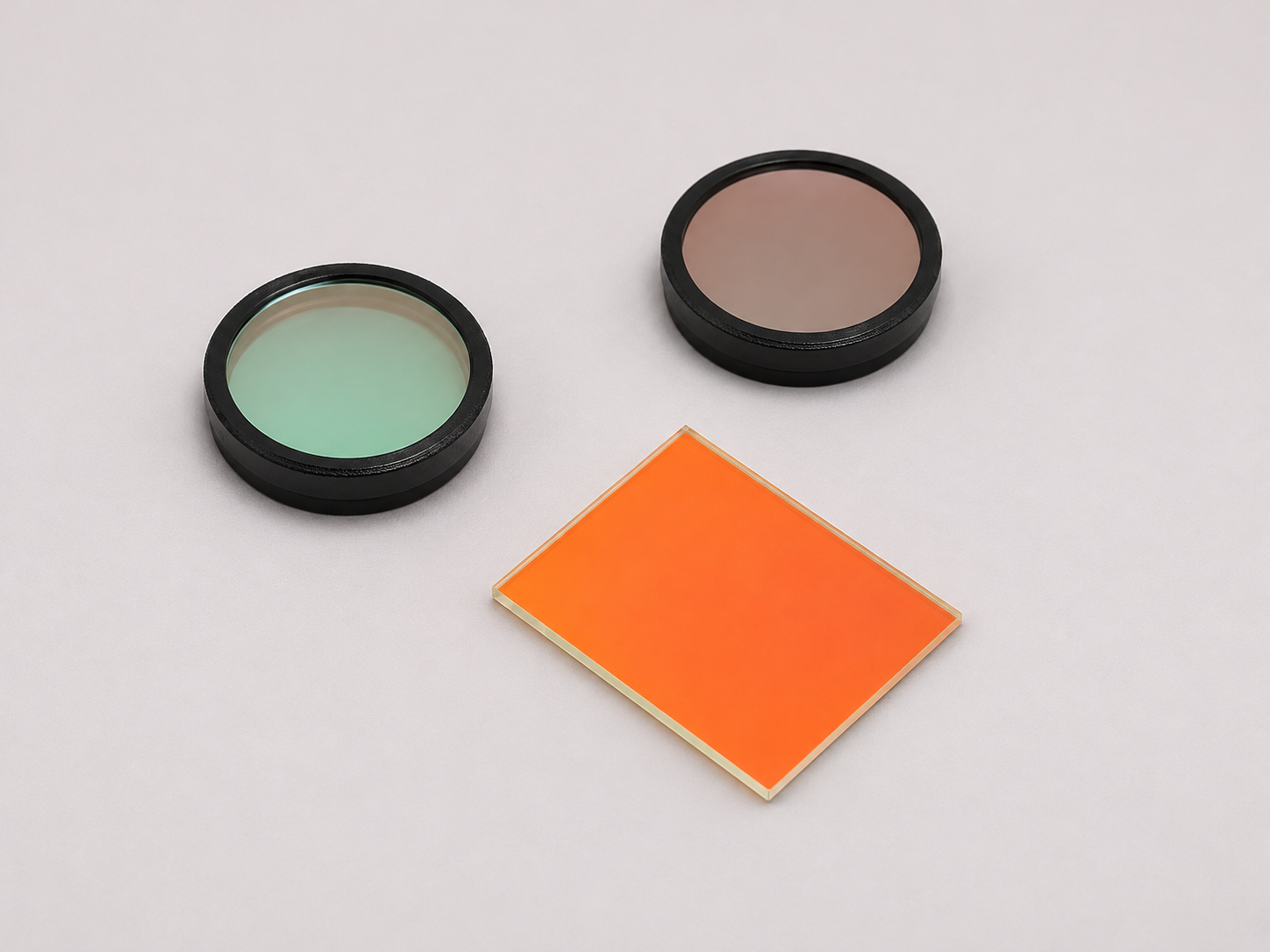
 PB01 · IMAGE PENDINGqPCR filter sets on a bench
qPCR Filters
Matched excitation, emission and dichroic filters for every dye channel
Excitation, Emission and Dichroic Filters for Real-Time PCR Instruments
A qPCR instrument reads several fluorescent dyes in the same well. Each dye channel needs its own excitation filter, emission filter and dichroic mirror.
We supply matched sets for nine channels, from Atto 425 to Cy®7, with centers from 430 to 800 nm.
Our PCR filters transmit at least 90% on average, block at OD6 on average from 350 to 800 nm, and above OD3 from 800 to 1,050 nm.
Standard sizes are 6 × 6 mm square and 6, 12 or 25 mm round, 1.0 or 1.1 mm thick, with optional alumina rings.
Our life-science filters reach up to 98% transmission at the design wavelength, with ultra-steep edges under 1% slope and sub-nanometer wavelength precision. They are made under an ISO 13485 quality system.
Custom centers from 400 to 850 nm and widths from 10 to 60 nm are available for new dyes or instruments. Learn more
How the Filters Work in a qPCR Instrument
Light from an LED or lamp passes the excitation filter, reflects off the dichroic mirror into the well, and excites the dye. The dye’s longer-wavelength emission passes back through the dichroic and the emission filter to the detector.
Each channel repeats this with its own three filters. Instruments switch channels by turning a filter wheel or by using one fixed optical module per channel, then read the channels one after another.
Because the excitation light is far brighter than the emission, the emission filter must block it deeply. That is why our PCR filters block at OD6 on average across the visible.
 D01 · IMAGE PENDINGLight path of one qPCR channel
Choosing PCR Filters
Match each filter to its dye. For FAM, the excitation filter is centered at 470 nm, 30 nm wide; the emission filter at 520 nm, 20 nm wide; and the dichroic reflects 450 to 490 nm and transmits 515 to 700 nm.
 D02 · IMAGE PENDINGOverlap between FAM emission and HEX excitation bands
Watch the neighbouring channel. FAM’s emission band, about 510 to 530 nm, overlaps HEX’s excitation band, about 520 to 540 nm. That is fine when channels are read one at a time, but not when both are lit together.
 T01 · IMAGE PENDINGMeasured curves of the FAM filter set
The excitation filter, emission filter and dichroic bands are overlaid with the 5-FAM absorption and fluorescence emission spectra.
Check blocking beyond the visible. Our standard PCR filters block above OD3 from 800 to 1,050 nm, enough for silicon detectors under LED light. If your source is a halogen lamp, ask for extended blocking to 1,100 nm.
Fit the mechanics. Choose 6 × 6 mm squares for compact modules, 6 or 12 mm rounds for filter wheels, or 25 mm rounds; 1.0 or 1.1 mm thickness; alumina rings if needed.
Buy the three filters of a channel together, so the edges of excitation, dichroic and emission are designed to fit. All PCR filter sets
So a 222 nm system needs JGS1 windows and optics; a 365 nm system can use JGS2, sapphire or BF33, but not K9. UV-grade windows
qPCR Channels and Matched Sets
| Channel (dyes) | Excitation center (nm) | Emission center (nm) | Set |
|---|---|---|---|
| Atto 425 | 430 | 480 | View Set |
| FAM / SYBR® Green | 470 | 520 | View Set |
| HEX / VIC® / JOE | 530 | 565 | View Set |
| Cy®3 / TAMRA | 543 | 585 | View Set |
| ROX / Texas Red® | 570 | 612 | View Set |
| Atto 633 | 620 | 655 | View Set |
| Cy5 / Quasar® 670 | 630 | 675 | View Set |
| Cy5.5 / Quasar® 705 | 675 | 725 | View Set |
| Cy7 | 725 | 800 | View Set |
Bandwidths and dichroic mirrors for each set are on the set pages. SYBR, VIC, Texas Red, Quasar and Cy are trademarks of their respective owners.
Single PCR Filters and Dichroics
Beyond the nine sets, we make single filters and dichroic mirrors for building or repairing PCR optics:
- 30 bandpass filters, 430 to 800 nm, 15 to 70 nm wide, ±2 nm
- 12 longpass dichroics at 45°, edges from about 450 to 770 nm
- 3 shortpass dichroics, edges at about 500, 550 and 565 nm
- Custom centers 400–850 nm, widths 10–60 nm
What to Send Us
- Dye or channel, or excitation and emission wavelengths
- Light source (LED or lamp) and detector
- Filter size, shape and thickness
- Ring or unmounted
- Annual quantity
Building a new qPCR instrument or adding a channel? Send us your dyes, light source, detector and filter size, and we will reply with a recommended set and a quote. Contact us