
Optical Coating Technology
Four PVD processes, chosen for each design
Every filter we sell is coated in our own chambers. An interference filter is a stack of thin layers, each a fraction of a wavelength thick, and the way those layers are deposited decides how sharp, stable and durable the filter will be. We run four physical vapor deposition (PVD) processes and pick the one that fits each design, from large batches of AR-coated windows to steep-edged laser filters with hundreds of layers.
Four Coating Processes
 D01 · IMAGE PENDINGE-beam evaporation chamber
E-Beam Evaporation
High-rate coating of large batches in a heated high vacuum. The economical choice for AR coatings and broadband designs.
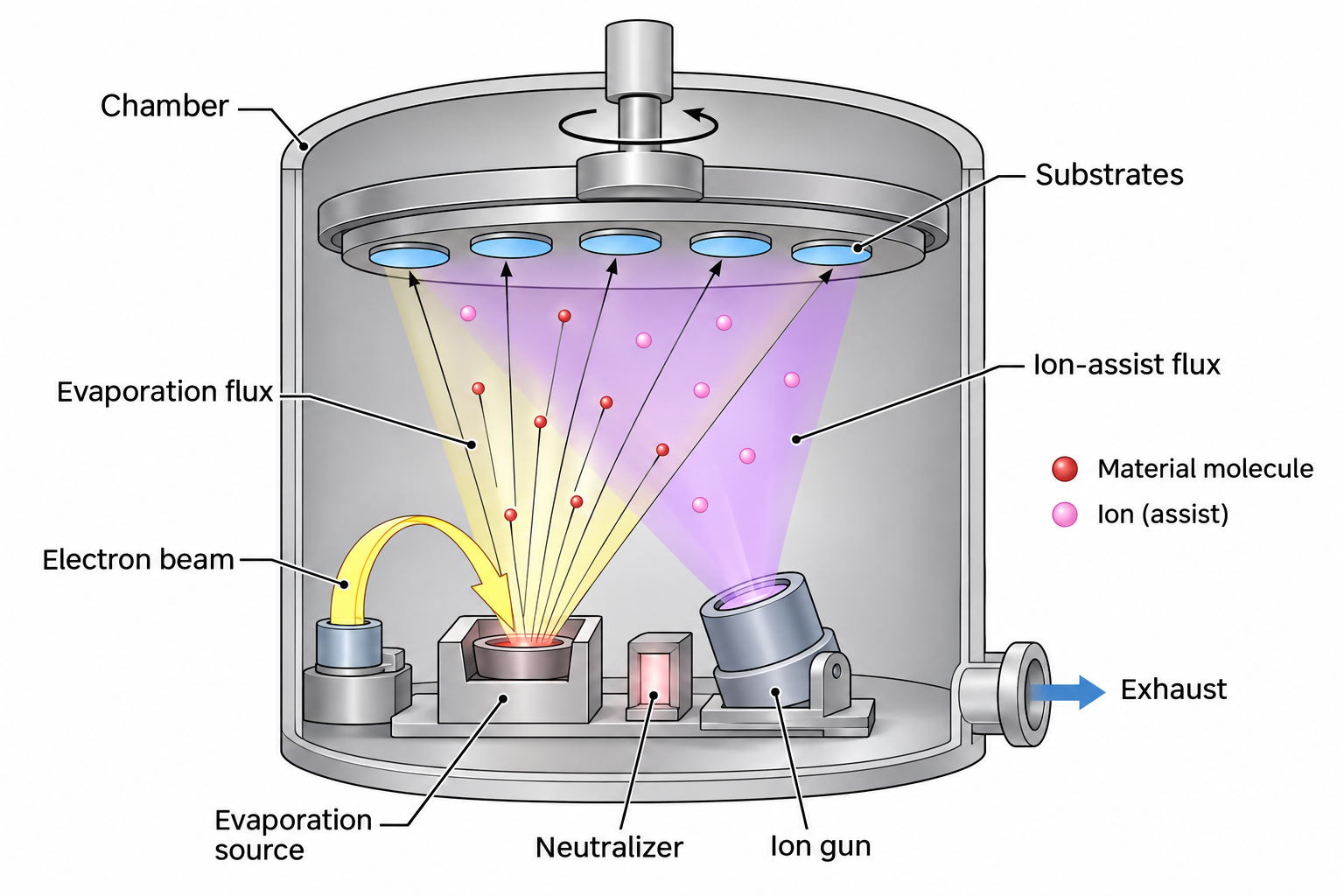 D02 · IMAGE PENDINGIon-assisted deposition chamber
Ion-Assisted Deposition
Evaporation plus plasma bombardment for dense layers with no thermal shift and low stress.
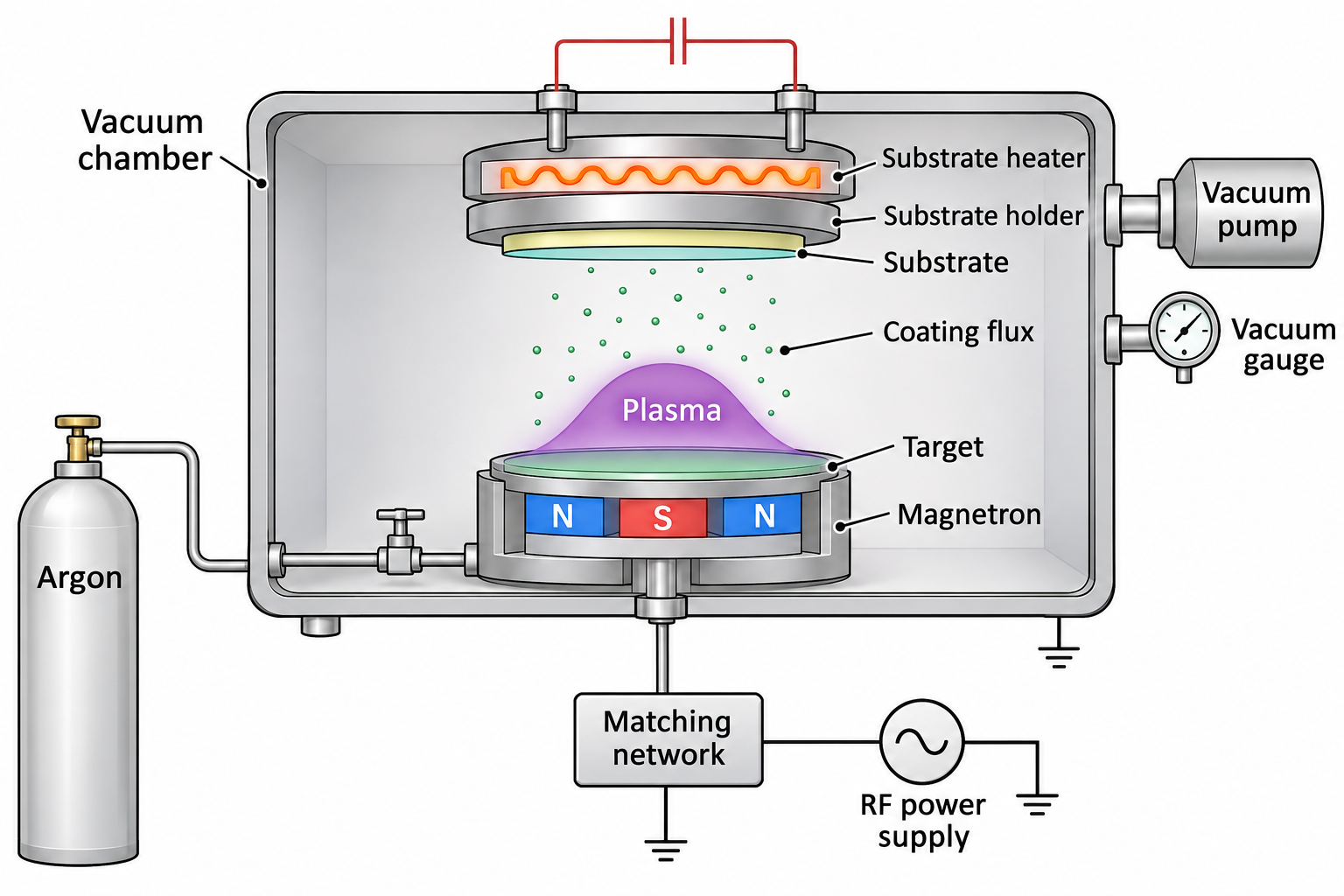 D03 · IMAGE PENDINGMagnetron sputtering chamber
Magnetron Sputtering
Sputtered metal oxidized into very dense, hard oxide layers for durable, stable filters.
 D04 · IMAGE PENDINGIon-beam sputtering chamber
Ion-Beam Sputtering
Cold, uniform deposition for the most demanding laser optics and ultra-narrow filters.
From Raw Glass to Coated Filter, Under One Roof
We started as a glass company, and we still make the substrates our filters are coated on. Keeping the whole chain in one place, from glass to coating to test, means fewer hand-offs and one team responsible for the result.
A typical filter goes through five stages here: the substrate is cut and polished, cleaned, coated, measured, then cut to its final size and inspected before packing. Each stage has its own checks, so a problem is caught where it starts rather than at final test.
Because we control the substrate, we can match glass to coating: fused silica for deep UV and high laser power, sapphire for hard-wearing windows, and optical glass such as K9, B270 or BF33 where cost matters.
What this means for you
One quote covers the whole filter, from glass to finished part. You do not need to source substrates separately, and changes to thickness, shape or material can be made without starting over with a new supplier.
Evaporation: E-Beam and Ion-Assisted
In electron-beam evaporation, a focused high-voltage electron beam heats the coating material in a water-cooled, rotating crucible to around 2,000 °C. The vapor condenses on substrates held in a high-vacuum chamber heated to about 250 °C. High rates and large batches make it cost-effective for AR coatings, mirrors and broadband filters.
Ion-assisted deposition adds a plasma source to the same chamber. The plasma bombards the growing film and packs it into a denser structure, so the filter shows no thermal shift and lower stress. It keeps the high deposition rate, and in the visible and near-infrared its laser damage threshold is typically close to standard e-beam coatings.
Sputtering: Magnetron and Ion-Beam
Magnetron sputtering deposits a thin metal layer from a magnetron plasma, then oxidizes it into a metal oxide with oxygen ions from a second plasma source. The result is very dense and hard.
Ion-beam sputtering knocks material off a metal or oxide target onto a vertically rotating substrate holder. It runs below 150 °C, and a standard machine coats uniformly over a zone about 300 mm across.
Magnetron sputtering deposits a thin metal layer from a magnetron plasma, then oxidizes it into a metal oxide with oxygen ions from a second plasma source. The result is very dense and hard, with excellent stability against humidity and temperature.
Ion-beam sputtering knocks material off a metal or oxide target onto a vertically rotating substrate holder. It runs below 150 °C, and a standard machine coats uniformly over a zone about 300 mm across. It is the key process for laser optics and for filters where every layer must land exactly.
What the Coating Process Changes
Edge steepness and layer count
Steep edges and very narrow bands need many layers deposited precisely. Sputtered and ion-assisted processes keep each layer on target, so we can build filters with more layers, steeper edges and deeper blocking.
Stability with temperature and humidity
Porous evaporated films absorb water and shift with humidity. Dense ion-assisted and sputtered films do not, so the passband stays where it was designed, in the lab or outdoors.
Durability
Hard oxide coatings resist abrasion, cleaning and humidity cycling. Choose them for windows, outdoor sensors and instruments that are cleaned often.
Laser damage threshold
For laser lines and high-power systems, the process, the materials and the cleaning before coating all affect how much power a filter survives. Tell us your laser’s power, pulse length and spot size, and we will choose the process to match.

Coating Your Substrates
The process is chosen for each design. Evaporation typically suits large batches and broadband designs where cost matters; ion assistance adds density and stability; sputtering suits steep edges, many layers and high laser power. Tell us your priorities and we will recommend the process.
Already have substrates, lenses or windows? We can coat customer-supplied parts with our filter, AR or functional coatings. Send us the material, size and quantity, and whether the parts arrive cleaned and inspected; we will confirm handling, fixturing and the test plan before we quote.
How Every Coating Run Is Controlled
- Substrates are cleaned and inspected before they go into the chamber.
- Layer thickness is controlled during deposition by optical monitoring.
- Witness samples from each run are measured on our spectrophotometers.
- Each run is recorded with its design, materials and test results.
Most coating defects start before the chamber door closes. Dust, residue or a scratched surface shows up later as pinholes or scatter, so cleaning and inspection come first.
During the run, layer thickness is monitored and the process stops each layer at its target. This is what keeps a 10 nm passband in the same place from one batch to the next.
After the run, a witness sample, or the filters themselves, are measured against the specification. Filters that miss are not shipped.
Each run keeps its own record, so a filter can be traced back to its coating batch and its measured curve. How we test
What We Coat

Bandpass and Laser-Line Filters
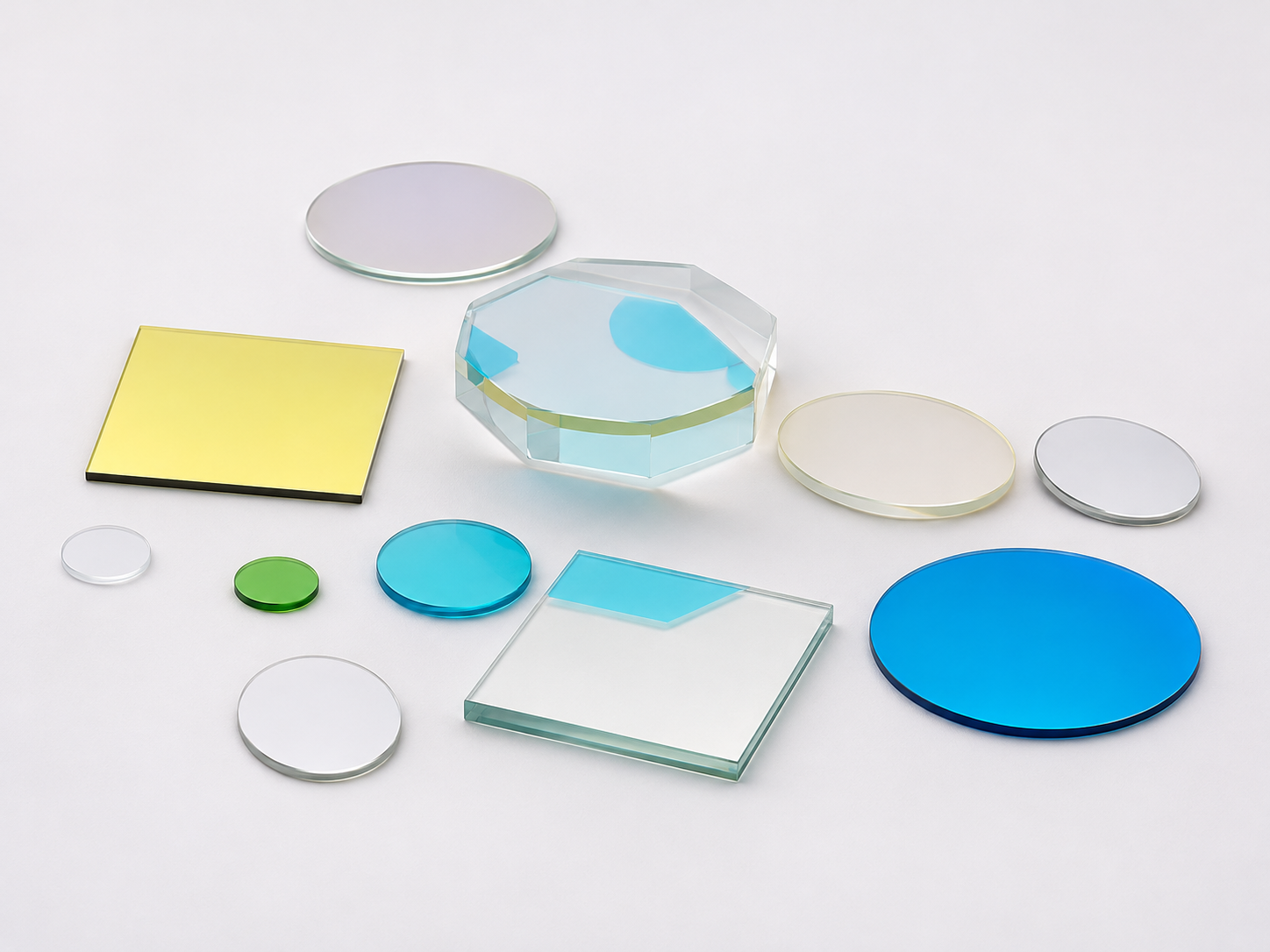
We also apply hard oxide AR coatings from 193 nm to 14 µm, diamond-like carbon (DLC) coatings on germanium and silicon optics, and coatings on fiber tips.
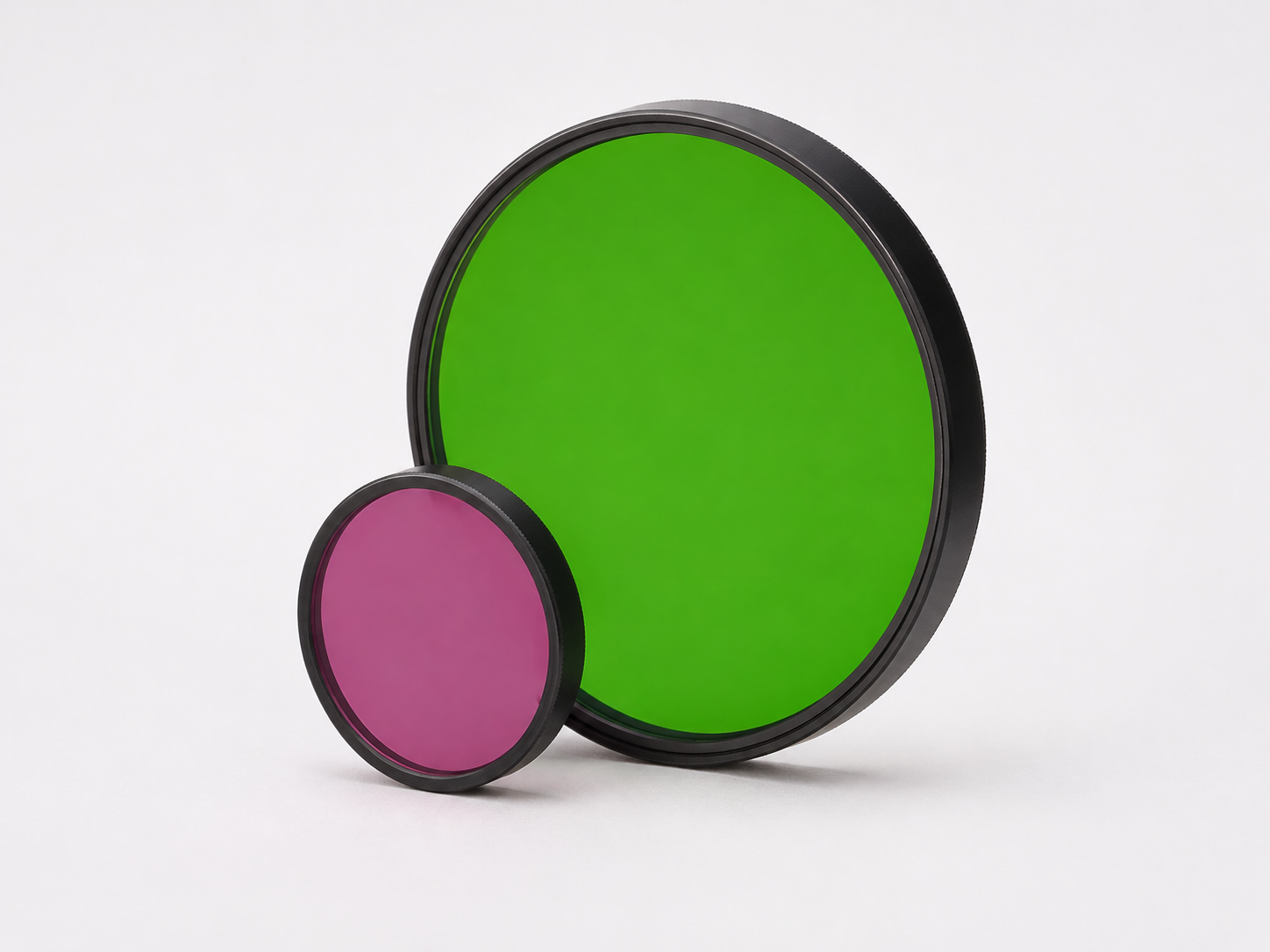
Edge Filters
Longpass and shortpass, including ultra-steep edges. Learn more

Dichroics and Beamsplitters
45° coatings measured in s and p polarization. Learn more
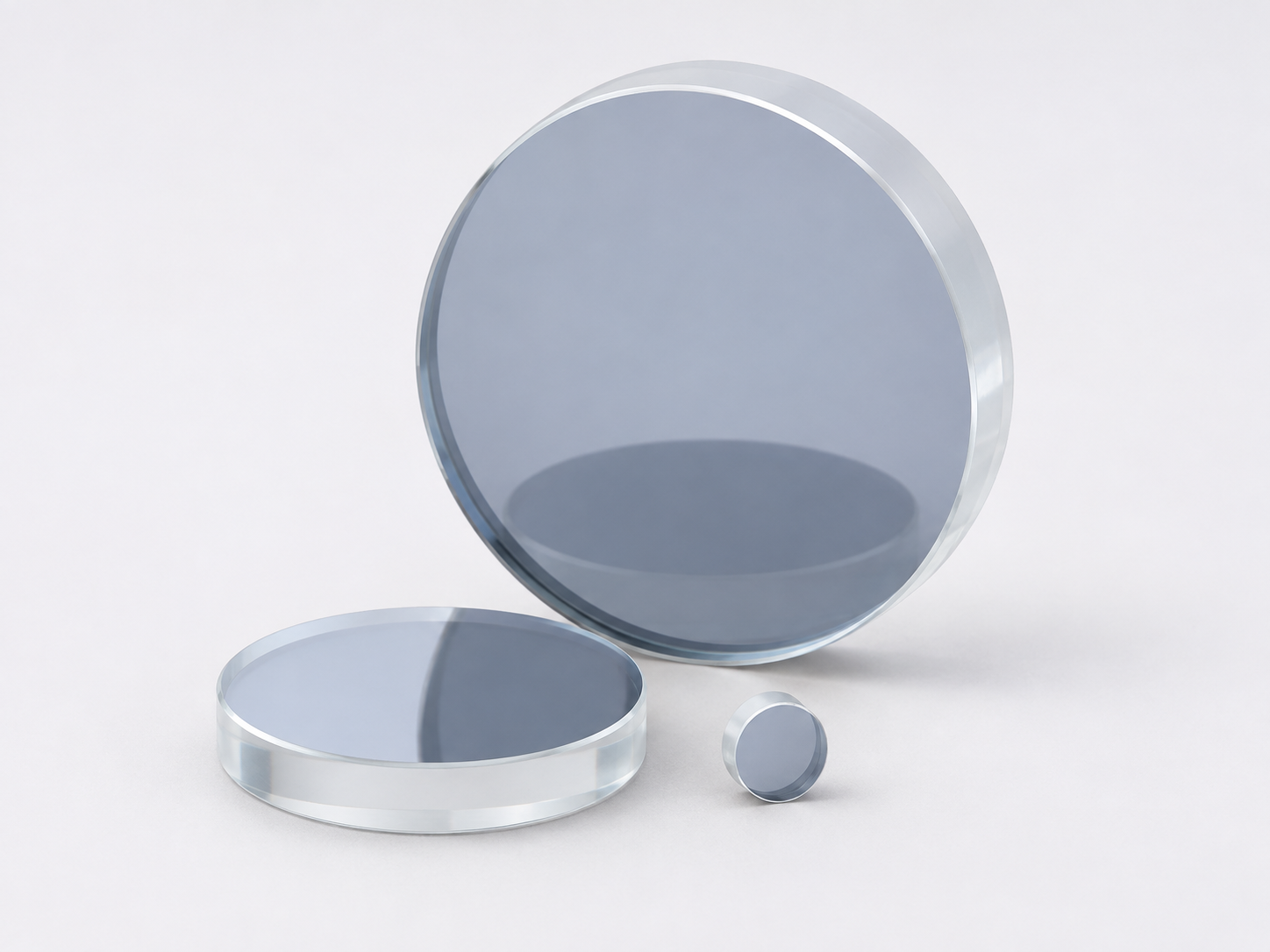
Mirrors
Dielectric laser mirrors, broadband and hot mirrors. Learn more

Anti-Reflection Coatings
Single- and double-sided AR on glass, fused silica and sapphire, up to 99% transmission. Learn more

Functional Layers
Conductive films with a set sheet resistance, ITO, anti-fog and water-repellent coatings. Learn more
Talk to a Coating Engineer
Each run is checked on our spectrophotometers before filters ship. How we test Ask about a coating
Tell us what the coating has to do: the band, the environment, the laser power, the quantity. We will recommend a process and a design, and tell you what it will take to make it.
Our coating floor runs multiple chambers across three coating rooms, for e-beam and ion-assisted deposition, magnetron sputtering and ion-beam sputtering.