
Notch Filters
Notch Filters That Remove a Laser Line and Keep Both Sides
When a laser line is drowning out your signal but you need the light on both sides of it, a notch filter removes just that narrow band and passes the rest.
We make Raman notch filters for 405, 785 and 808 nm lasers, 20 to 35 nm wide, with OD4 blocking at the laser line.
Outside the notch they transmit 88 to 93% on average, from as short as 320 nm up to 1,100 or 1,200 nm.
For multiphoton microscopy we also make wider notches, up to a 95 nm band blocked at OD3.
We also make custom notches from 10 to 200 nm wide, with OD4 to OD6 blocking. Specify a custom filter
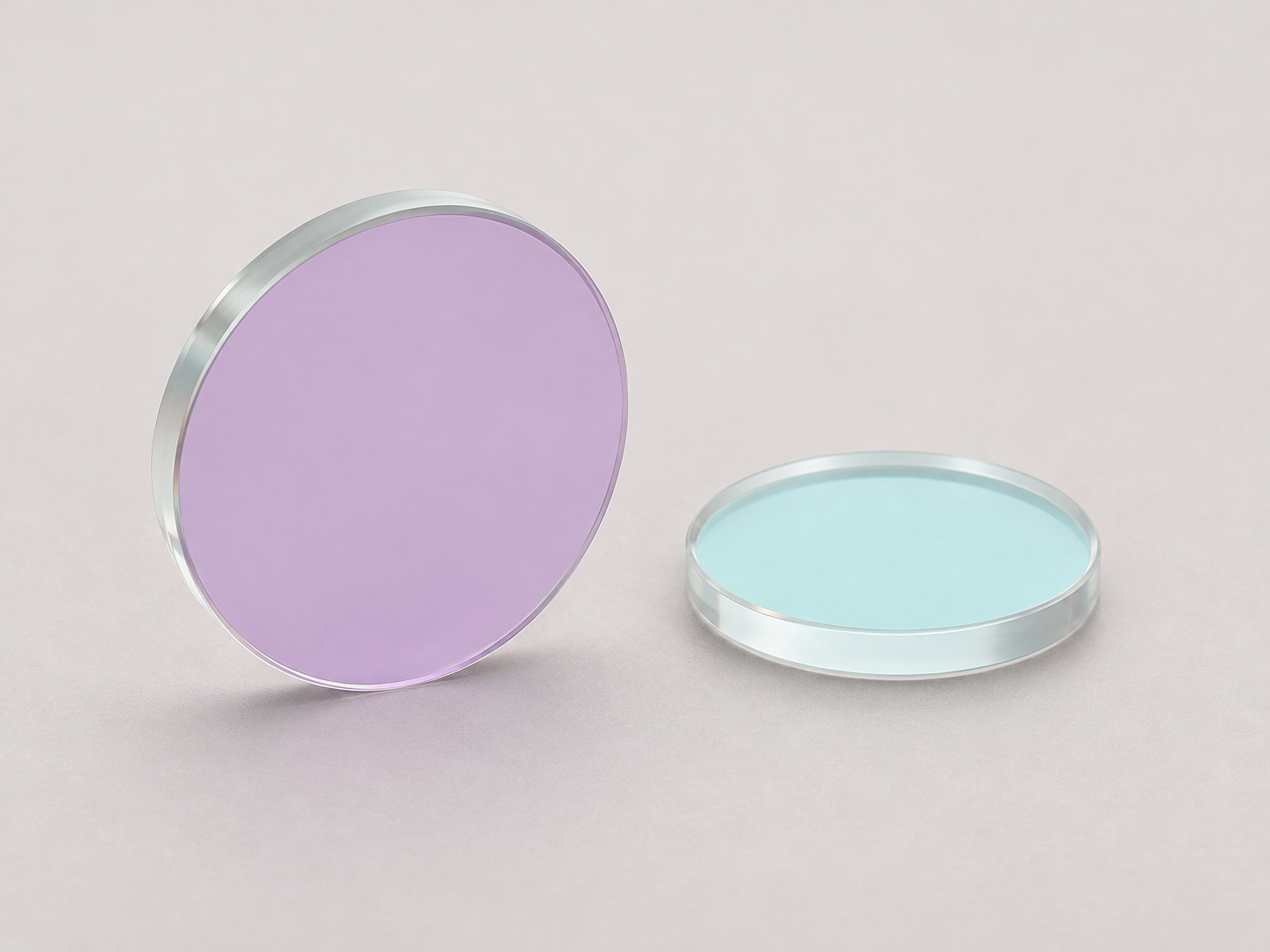
Notch or Longpass?
A longpass filter removes the laser line and everything shorter than it. A notch filter removes only the laser line, so you keep the signal on the short side as well as the long side.
In Raman spectroscopy that means you can record both Stokes and anti-Stokes lines with one filter. In fluorescence work it lets you remove one laser from a multi-laser system without losing the other channels.
If you only need the long-wavelength side, a longpass filter is simpler to specify. Longpass filters
 D01 · IMAGE PENDINGRaman light path with the notch filter highlighted
A notch filter rejects the laser wavelength while allowing Raman-shifted light to reach the detector.
Where a Notch Filter Sits in a Raman System
A typical Raman setup uses two filters. On the laser side, an ultra-narrow laser-line filter removes the laser’s broadband background. The clean beam excites the sample, and the scattered light returns to the collection path.
On the collection side, the notch filter removes the strong laser line before the light enters the spectrometer. Raman light is many orders of magnitude weaker than the laser, which is why the notch must block deeply at exactly the laser wavelength.
Our 405, 785 and 808 nm notches block at OD4 at the laser line, at 0 ± 3° incidence and a 3° cone half-angle. Pair them with a laser-line filter at the same wavelength. Laser-line filters
Choosing a Notch Filter
Match the Laser
The notch must be centered on your laser wavelength and wide enough to cover the laser’s tolerance and any drift with temperature or angle. Our 20 to 35 nm notches leave ample margin for a laser line with a few nanometres of spread.
Check the Closest Raman Shift
Notch width sets how close to the laser you can measure. With our 785 nm notch, transmission resumes at 810 nm, about 390 cm⁻¹ from the laser, and at 760 nm on the anti-Stokes side, about 420 cm⁻¹.
The 808 nm notch reaches about 330 cm⁻¹ on the Stokes side and 440 cm⁻¹ on the anti-Stokes side; the 405 nm notch reaches about 770 and 950 cm⁻¹. If you need lines closer than that, ask us for a narrower notch.
Then check the outer ends of the pass bands: 1,100 nm for the 785 nm notch and 1,200 nm for the 808 nm notch, enough to cover a silicon detector’s Raman range.
What to Specify for a Notch Filter
Have these ready when you ask for a quote. If you are unsure of some, tell us about your system and we will help fill them in:
- Laser wavelength and its tolerance
- Notch width, or the closest shift to keep
- Blocking OD at the laser line
- Pass bands on both sides of the notch
- Angle of incidence: 0° or 45°
- Operating temperature range
- Size, thickness and mounting
Related Filter Types
- Raman spectroscopy filters Learn more
- Multiphoton microscopy filters Learn more
- Dichroic mirrors Learn more
Standard Notch Filters
| Model | Notch center (nm) | Notch width (nm) | Blocking | Pass bands (nm) | Transmission | AOI | Use |
|---|---|---|---|---|---|---|---|
| Notch 405nm-20nm | 405 | 20 (typ.) | OD4 at 405 nm | 320–390 / 418–580 | > 88% / > 90% (avg) | 0 ± 3° | Raman |
| Multiphoton N-515-20 | 515 | about 20 | OD3 at 515 nm | 400–500 / 530–700 | > 90% | 0° | Multiphoton |
| Multiphoton N-570-665 | — | 95 (570–665) | OD3 | 500–565 / 675–750 | > 92% (peak) | 0° | Multiphoton |
| Notch 785nm-35nm | 785 | 35 (typ.) | OD4 at 785 nm | 580–760 / 810–1,100 | > 93% (avg) | 0 ± 3° | Raman |
| Notch 808nm-35nm | 808 | 35 (typ.) | OD4 at 808 nm | 600–780 / 830–1,200 | > 93% (avg) | 0 ± 3° | Raman |
| Multiphoton N-940=30% | 940 | — | T = 30% at 940 nm (partial) | 530–890 / 1,010–1,600 | > 90% | 0° | Multiphoton |
All these notch filters are specified for a 3° cone half-angle. The 940 nm filter is a partial notch: it cuts transmission to 30% at 940 nm rather than blocking it.
Using a different laser? Send us the laser wavelength and tolerance, the closest Raman shift or wavelength you need to keep, the blocking OD, angle of incidence and operating temperature, and we will reply with a quote and a recommended design. Contact us