
Ultra-Narrow Bandpass Filters
Laser-Line Filters with FWHM Below 2 nm
Some jobs need a filter that lets one laser line through and almost nothing beside it. An ultra-narrow bandpass filter passes a band a nanometre or less wide, enough to isolate a single laser line or atomic emission line.
We make them for the common lines at 514, 532, 589, 785, 1,031 and 1,064 nm, from under 2 nm wide down to under 0.3 nm.
Center wavelength is held to ±0.3 nm at 514 to 589 nm and ±0.5 nm at 785 to 1,064 nm. Peak transmission is 65 to 85%.
On both sides of the line they block to OD4–OD6; the blocking range of each filter is in the table below.
Semi-custom laser-line and emission-line filters go down to 0.15 nm wide, for lines such as H-alpha, HeNe, argon, sodium, mercury and Nd:YAG, and our narrowband measurements resolve features down to 0.0025 nm.
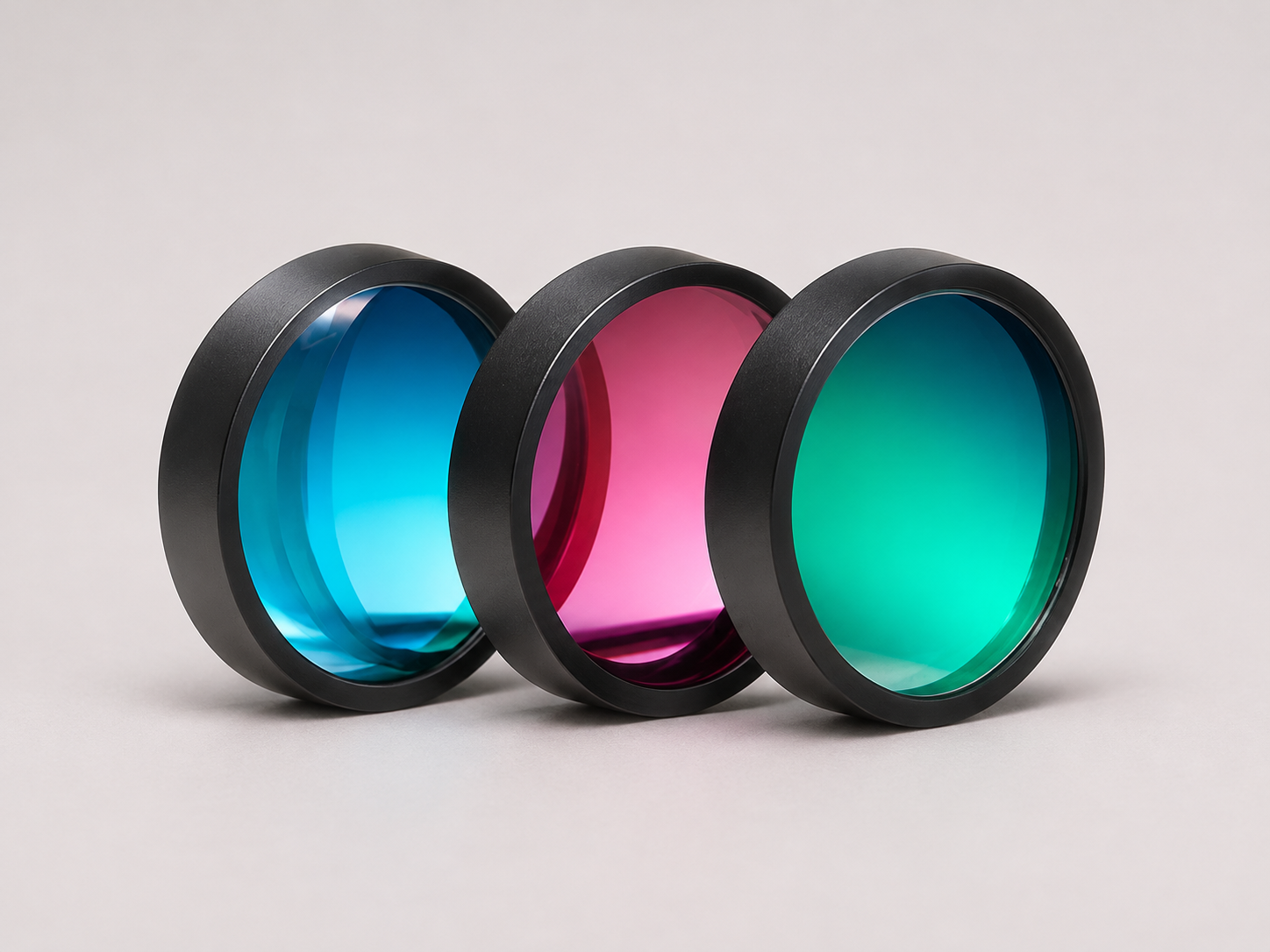
All are multi-cavity designs, made to sit face-on to the beam. Working at another line? Ask us for a custom design. Learn more
When You Need an Ultra-Narrow Filter
Use one when a 10 nm filter still lets through too much light next to your line. Typical cases are cleaning up a Raman excitation laser at 514, 532, 785 or 1,064 nm, and isolating the 589 nm sodium line.
Laser diodes and many solid-state lasers emit a weak, broad background around the main line. An ultra-narrow filter in front of the laser passes the line and removes that background before it reaches the sample.
On the collection side, pair it with a notch or longpass filter that blocks the laser line itself. If 4 to 25 nm FWHM is enough, a narrowband filter is easier to use. Learn more
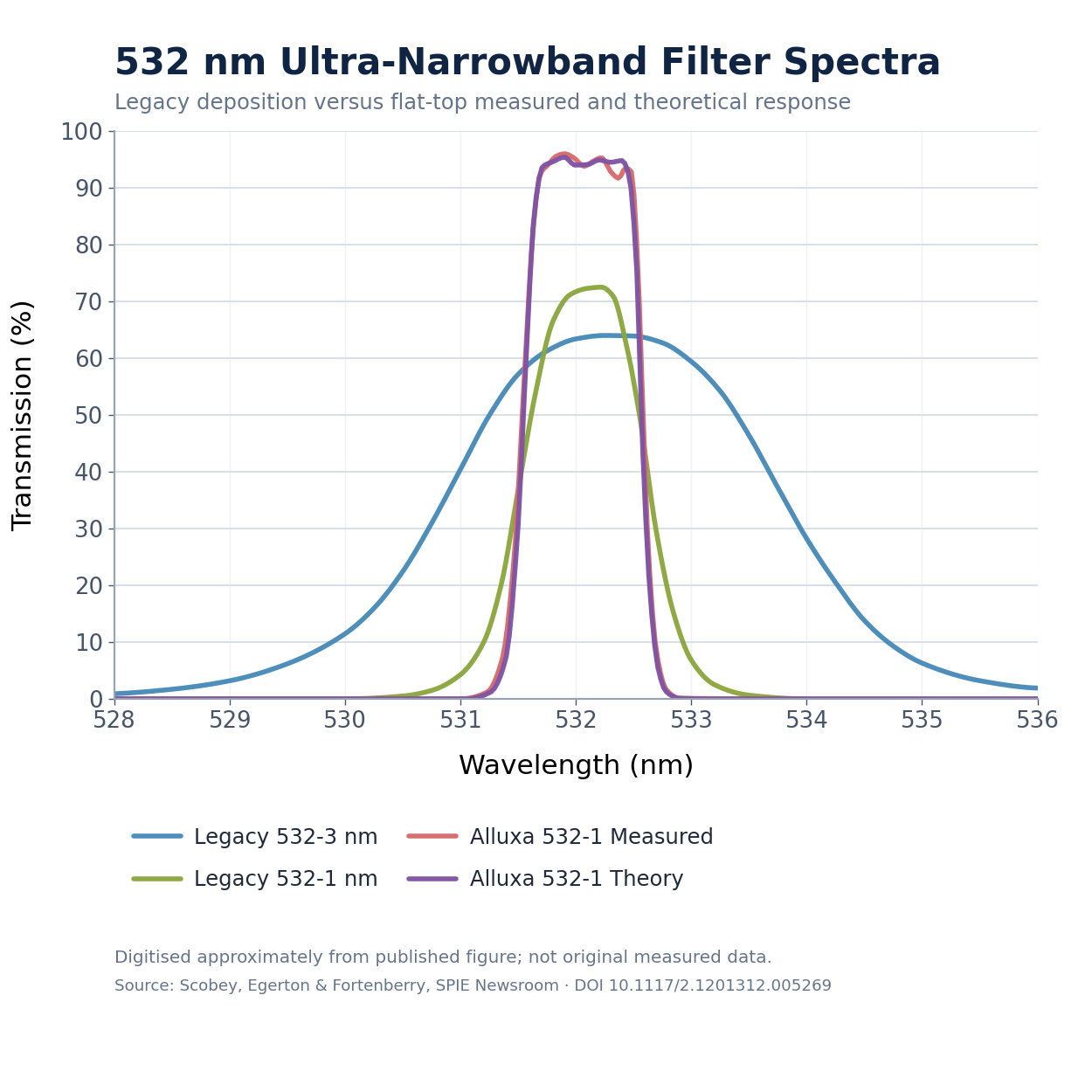 T01 · IMAGE PENDINGMeasured spectra of three Ultra-NBP532-1 versions
The 532 nm curves compare broader legacy passbands with narrower flat-top filter designs and their peak transmission.
Narrower is not free. At 532 nm the trade-off looks like this: FWHM under 1 nm (typically 0.8 nm) with peak transmission above 80%; under 0.6 nm with above 70%; under 0.3 nm with above 65%.
Each step narrower removes more of the laser’s background, and each step costs some of the signal. Pick the widest filter that still meets your background limit.
In the near-infrared, our 1,031 and 1,064 nm filters reach FWHM under 0.7 and 0.5 nm while keeping peak transmission above 85% and blocking above OD6.
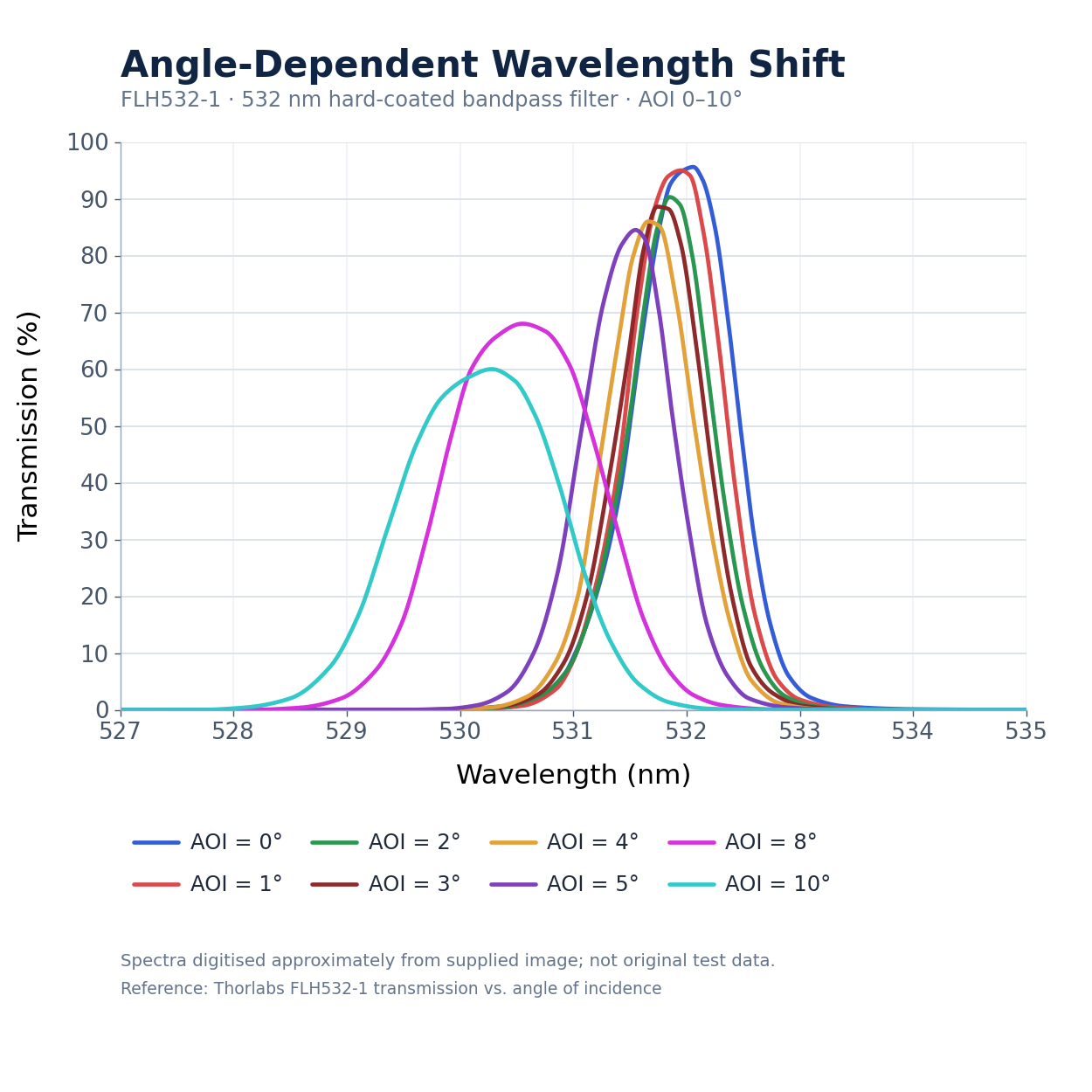 D01 · IMAGE PENDINGA 0.3 nm filter at 0, 1 and 3 degrees against a 532 nm laser line
The 532 nm passband shifts toward shorter wavelengths as the angle of incidence increases from 0 to 10 degrees.
Angle, Temperature and Measurement
At this width, small changes matter. Using the standard tilt formula, a 532 nm filter moves about 0.02–0.04 nm at 1°, 0.17–0.35 nm at 3° and 0.5–1.0 nm at 5°, depending on its effective index. A 3° tilt can move a 0.3 nm filter off the line.
Temperature works the same way. At typical drifts of 0.01–0.035 nm per °C, a 10 °C change moves the center 0.1–0.35 nm. Mount these filters square to the beam, keep them near their design temperature, or use a small tilt to tune them onto your line.
We measure every ultra-narrow filter on our Cary 5000 with a data step of 0.1 nm or finer, so the curve you receive shows the true peak shape. Angle and temperature in detail
Standard Ultra-Narrow Filters
| Model | CWL (nm) | FWHM (nm) | Peak T | Blocking | Blocking range (nm) | AOI |
|---|---|---|---|---|---|---|
| Ultra-NBP514-2 | 514 ± 0.3 | < 2 | > 80% | OD4 | 350–507, 521–900 | 0° |
| Ultra-NBP532-1 (FWHM < 1 nm) | 532 ± 0.3 | < 1 (typ. 0.8) | > 80% | OD5 | 350–521, 543–900 | 0° |
| Ultra-NBP532-1 (FWHM < 0.6 nm) | 532 ± 0.3 | < 0.6 | > 70% | OD5 | 350–521, 543–900 | 0° |
| Ultra-NBP532-1 (FWHM < 0.3 nm) | 532 ± 0.3 | < 0.3 | > 65% | OD5 | 350–521, 543–900 | 0° |
| Ultra-NBP589-1.2 | 589 ± 0.3 | < 1.2 | > 80% | OD4 | 350–576, 603–900 | 0° |
| Ultra-NBP785-1.2 | 785 ± 0.5 | < 1.2 | > 80% | OD4 | 400–775, 795–900 | 0° |
| Ultra-NBP1031-0.7 | 1,031 ± 0.5 | < 0.7 | > 85% | OD6 | 950–1,028, 1,034–1,150 | 0° |
| Ultra-NBP1064-0.5 | 1,064 ± 0.5 | < 0.5 | > 85% | OD6 | 950–1,050, 1,056–1,150 | 0° |
Need a different laser line? Send us the line wavelength and its tolerance, the FWHM and peak transmission you need, the blocking OD and range, and your operating temperature, and we will reply with a quote and a recommended design. Contact us