
UV Filters
Pick a standard filter below, or send us your wavelength for a custom design.
UV Bandpass Filters at 222 nm and 365 nm
UV lamps and LEDs rarely emit just the line you want, and UV detectors often see visible and near-infrared light too. A UV bandpass filter passes your one ultraviolet line and blocks the rest.
For 365 nm we make 10 and 40 nm wide filters that pass more than 85% and block to OD3 or OD4 from 200 to 1,000 nm.
For far-UV work at 222 nm we make a 20 nm wide filter that passes more than 30% and blocks to OD3 from 200 to 1,100 nm.
We also make UV-blocking longpass filters, UV dichroics and windows that transmit from 200 nm; see the list further down.
Standard UV bandpass filters cover 193 to 380 nm, 10 to 40 nm wide, with 12% to 40% transmission and OD4 average blocking. Metal coatings serve the deep UV and dielectric coatings work from 260 nm, in standard sizes from 12.5 to 50 mm.

Working at another UV line? Ask us for a custom design. Specify a custom filter
UVA, UVB or UVC?
Ultraviolet is usually divided into UVA (315 to 400 nm), UVB (280 to 315 nm) and UVC (below 280 nm). Each step shorter needs different coatings, substrates and detectors.
Our 365 nm filters are in UVA, matched to the common 365 nm mercury line and UV LEDs. Our 222 nm filter is in UVC, where far-UV lamps emit.
We don’t have a standard UVB filter. If you need one, send us the line and bandwidth and we will design it.
What to Check for UV Filters
Expect less transmission deeper in the UV. Our 365 nm filters pass above 85%; our 222 nm filter passes above 30%. If your signal is weak, plan for that loss or ask what is possible at your line.
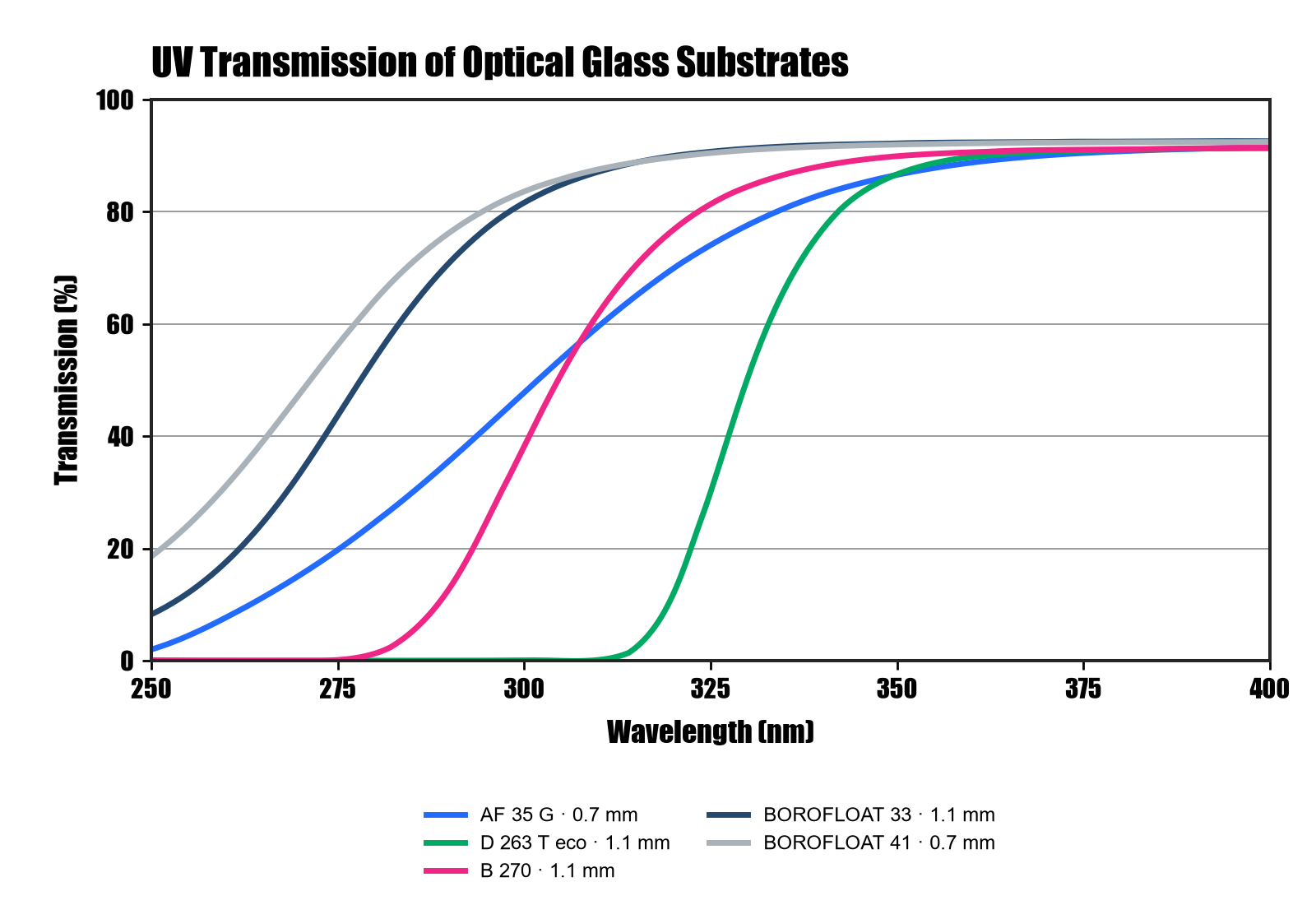 D01 · IMAGE PENDINGUV transmission start of common substrates
Check the long-wavelength blocking. Many UV sources also emit visible and infrared light, and silicon detectors respond out to about 1,100 nm. Our 222 nm filter blocks at OD3 all the way to 1,100 nm.
Choose a substrate that transmits your line. JGS1 fused silica transmits from 200 nm and JGS2 from 250 nm, while sapphire, BF33 and K9 glass start at 350 to 370 nm.
So a 222 nm system needs JGS1 windows and optics; a 365 nm system can use JGS2, sapphire or BF33, but not K9. UV-grade windows
Tell us your source power and exposure time as well. UV durability data for our coatings is available on request.
Other Filters That Work in the UV
These filters belong to other families but are made for ultraviolet light:
- Longpass at 235 nm: reflects 200–230 nm, passes 245–1,100 nm
- Longpass at 400 nm: blocks UV, passes from 400 nm
- Dichroic that passes 340 nm and reflects visible light
- Dichroic that reflects UV and passes visible light
- Dichroic for DAPI sets: reflects 340–400 nm
- 405 nm notch: passes 320–390 nm below the notch
- 50% attenuator: neutral from 300 to 1,800 nm
Standard UV Bandpass Filters
| Model | CWL (nm) | FWHM (nm) | Avg. T | Blocking | Blocking range (nm) | AOI |
|---|---|---|---|---|---|---|
| BP220 | 222 ± 2 | 20 ± 2 | > 30% | OD3 | 200–1,100 | 0° |
| BP365/10,OD4 | 365 ± 2 | 10 ± 2 | > 85% | OD4 | 200–352 / 385–1,000 | 0° |
| BP365-40,OD3 | 365 ± 2 | 40 ± 2 | > 85% | OD3 | 200–342 / 392–1,000 | 0° |
| BP365/40,OD4 | 365 ± 2 | 40 ± 2 | > 85% (355–375) | OD4 | 200–340 / 390–1,000 | 0° |
All specified at 0° with a 3.5° cone half-angle.
Need another UV line? Send us the center wavelength and width, the blocking you need from the UV to the near-infrared, your source and detector, and the size, and we will reply with a quote and a recommended design. Contact us