
Multiphoton Microscopy Filters
Shortpass emission filters that stop the femtosecond laser
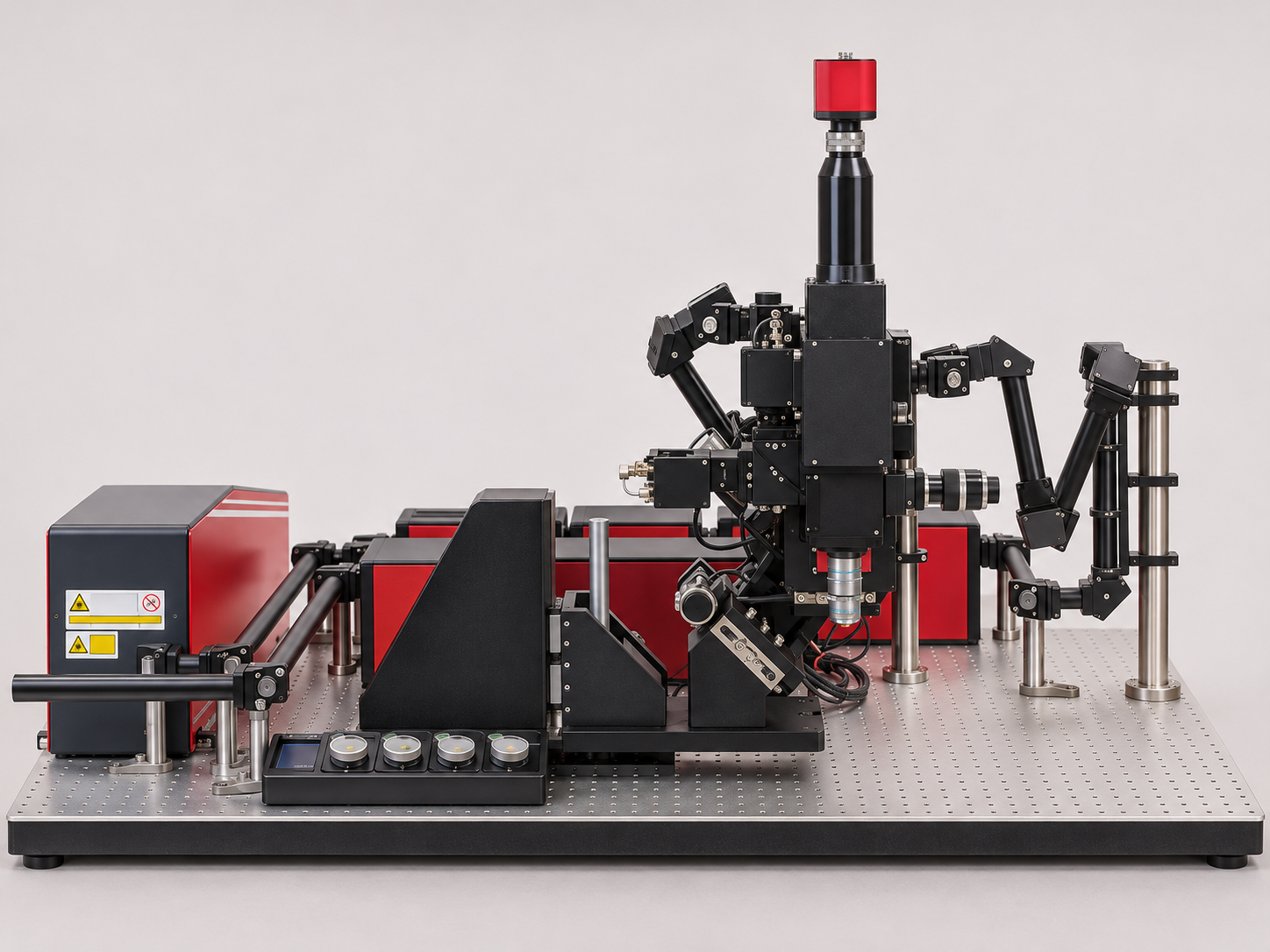 PB01 · IMAGE PENDINGMultiphoton shortpass emission filters
Emission Filters That Block the Femtosecond Laser
In multiphoton imaging, the excitation laser sits at longer wavelengths than the fluorescence. The emission filter must pass the fluorescence and stop the laser.
We make eight multiphoton shortpass filters with edges from 490 to 1,530 nm, passing over 90% on average.
Blocking reaches OD6 from 810 to 1,500 nm on our 800 nm shortpass filter, the usual choice for Ti:Sapphire lasers.
Three notch filters complete the range, for blocking a single line or band between two channels.
Need a different edge or size? Specify a custom filter

Why Multiphoton Needs Shortpass Filters
Two or three photons are absorbed at once, so the excitation wavelength is roughly two or three times the one-photon value. Common sources are Ti:Sapphire lasers at 700 to 1,000 nm and Cr:LiSAF lasers at 800 to 900 nm.
The fluorescence comes out shorter, in the visible. A shortpass filter is the natural fit: pass everything below the edge, block the laser above it.
The laser is far brighter than the signal, so blocking depth at the laser wavelength matters more than anything else.
Where the Filters Sit
After the objective, a primary dichroic typically separates the returning fluorescence from the laser path and sends it toward the detectors.
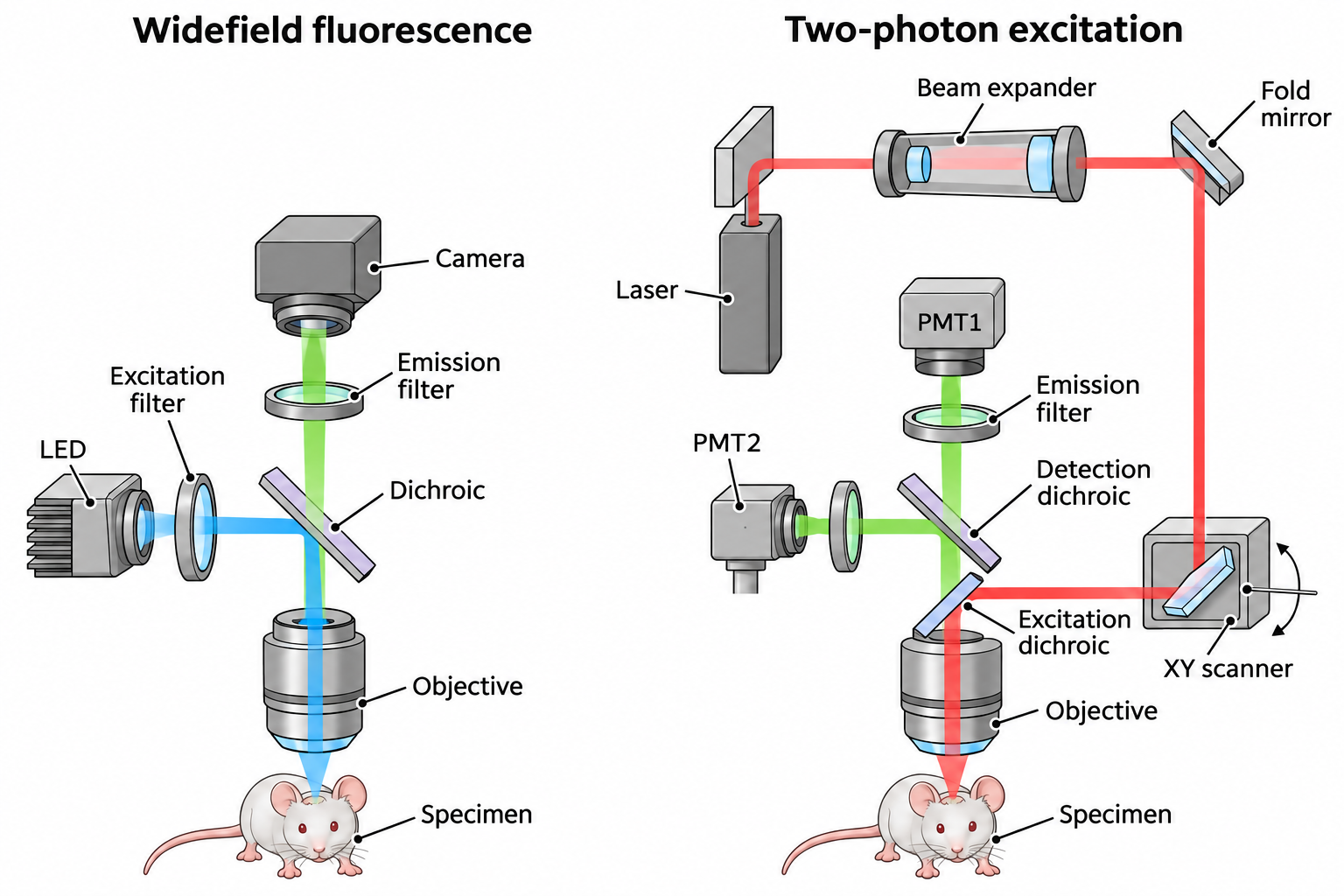 D01 · IMAGE PENDINGMultiphoton microscope light path
A multiphoton shortpass emission filter follows, in front of the detectors, to remove the laser light that leaks through the dichroic.
Our 490 and 520 nm shortpass filters and the 570–665 nm notch can serve as channel filters, separating blue from green or green from red.
Dichroics for the primary and channel splits are made to your design. View details
For two or more colors, secondary dichroics split the fluorescence into channels, and each channel gets its own emission filter.
Choosing by Laser Wavelength
| Your laser | Shortpass that blocks it | Notes |
|---|---|---|
| 700–720 nm | Multiphoton SP650 | Blocks from 685 nm; passes to 640 nm |
| 720–800 nm | Multiphoton SP690, Multiphoton SP700 | Block from 720 or 725 nm |
| 810–1,000 nm (Ti:Sapphire, Cr:LiSAF) | Multiphoton SP800 | OD6 to 1,500 nm; passes 500–795 nm |
| 1,000–1,100 nm | Multiphoton SP980 | Blocks from 995 nm; passes 450–960 nm |
| Above 1,540 nm | Multiphoton SP1530 | OD6 to 1,800 nm; passes 900–1,510 nm |
Channel filters: 490 nm shortpass and 520 nm shortpass filters pass blue or blue-green and block longer wavelengths. Notches: a 515 nm notch blocks 515 nm, a 570–665 nm notch blocks that band, and a 940 nm partial notch reduces 940 nm to 30%.
Worked Example: From Dye to Filter
| Fluorophore | One-photon excitation (nm) | × 2 (nm) | Emission (nm) | Suggested shortpass |
|---|---|---|---|---|
| NADH | 340 | about 680 | 450 | SP650, with the laser tuned above 685 nm |
| GFP | 488 | about 976 | 507 | SP800 |
| RFP | 532 | about 1,064 | 588 | SP980 or SP800 |
Doubling the one-photon wavelength is only a starting point; real two-photon peaks often differ, so check your dye’s two-photon spectrum and tell us the laser you will actually use.
About the OD values. Blocking above 800 nm on several of these filters is marked with an asterisk on their pages. At OD2 and beyond, the signal left at those wavelengths approaches our spectrophotometer’s noise floor, so the real blocking may be deeper than the number shown. If your system needs a verified OD at your laser line, tell us and we will discuss how to test it.
What to Send Us
- Laser type and wavelength range
- Fluorophores or channels you image
- Two-photon or three-photon
- Filter size and mount
- Detector type
- Blocking needed at the laser
Building or upgrading a multiphoton microscope? Send us your laser range and fluorophores, and we will recommend the shortpass and channel filters and send a quote. Contact us